If you’ve just moved to Spain (or you’re spending long periods here), you’ll quickly hear two words that sound similar but do very different jobs:
- NIE (Número de Identidad de Extranjero): your foreigners’ identification number used for legal, administrative, tax, banking, property, work, and immigration paperwork.
- Padrón (Empadronamiento): your municipal registration with the town hall (Ayuntamiento) confirming your address and local residency in that municipality.
The big question people Google at 2am is:
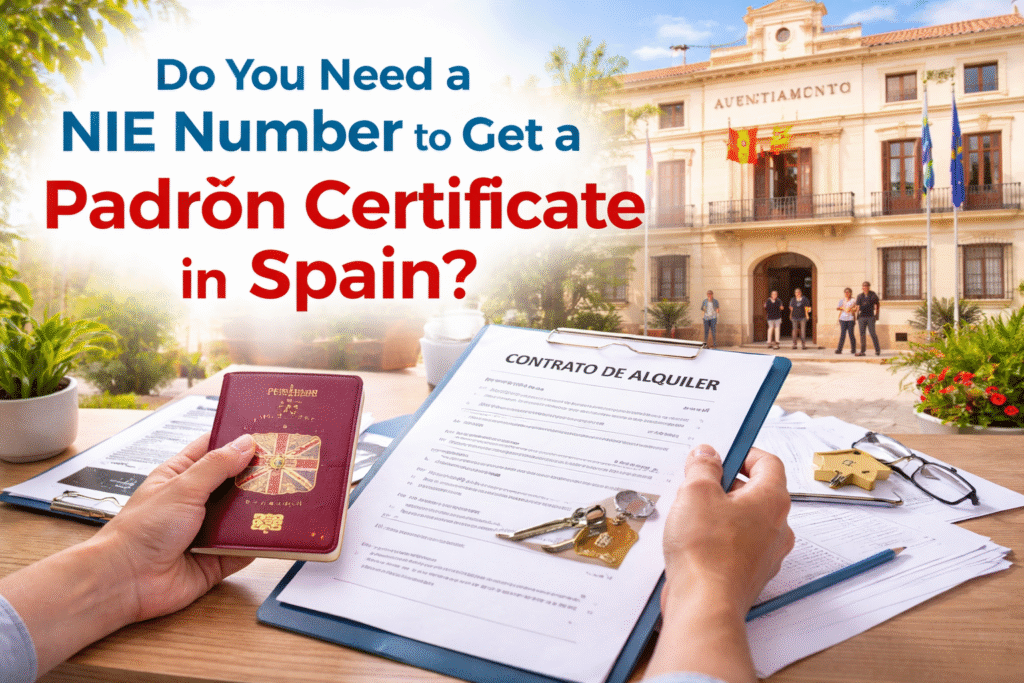
Do you need a NIE number to get a padrón certificate (certificado de empadronamiento) in Spain?
In most cases: No — you don’t strictly need a NIE to register on the padrón, and many town halls will register you using your passport (or EU ID card).
But in practice: some town halls prefer or request a NIE, and procedures can vary by municipality, appointment system, and even the clerk you get on the day.
This guide breaks down the legal logic, the real-life reality, and exactly what to do if your town hall says “NIE required.”
What the Padrón Is (And Why Spain Cares)
The padrón municipal is a register of everyone who lives in a municipality. It’s run by your local Ayuntamiento. Being on it helps the town plan services (healthcare, schools, social services, waste collection, policing, etc.). It also affects municipal funding.
For you, the padrón is more personal. It’s used as proof that you live at an address and is often required for:
- School places
- Healthcare registration (in some situations/regions)
- Driving licence swaps (depending on procedure)
- Residency applications (EU registration certificate, TIE processes, etc.)
- Family reunification paperwork
- Spanish immigration procedures where proof of address is needed
- Local services and discounts in some towns
Important detail: the padrón is not an immigration status. It does not “make you legal” or “give you residency.” It’s a municipal record of where you live.
What a NIE Is (And Why It Gets Confused With the Padrón)
A NIE is an identification number assigned to foreigners dealing with Spanish administration. It’s like your “foreigner file number” used across many systems.
You’ll need a NIE for things like:
- Buying property
- Opening many bank accounts
- Getting a work contract / being paid on payroll
- Paying taxes / registering as self-employed
- Buying a car, insurance, utilities in your name (often)
- Residency cards and many immigration steps
So it’s easy to assume: Spain = paperwork = NIE required.
But the padrón isn’t automatically tied to the NIE. The padrón is tied to you + your identity document + your address. Your identity document can be a passport.
The Straight Answer: Is a NIE Required for Empadronamiento?
In principle (the “rules” view)
No. In many municipalities, a passport is enough, especially if you’re a non-EU citizen who hasn’t yet got a NIE/TIE, or an EU citizen who hasn’t completed their NIE paperwork.
In practice (the “Spain paperwork” view)
It depends on:
- The Ayuntamiento and how strict their internal checklist is
- The online booking form (some websites force a NIE field)
- Whether you are applying alone, as a family, or as a tenant
- Whether you can show strong proof of address
- Local habits: some town halls get used to seeing NIEs and ask for them “by default”
So the correct, useful answer is:
✅ You usually can get a padrón without a NIE
⚠️ But you must bring the right documents, and some town halls may push back
✅ You can often solve pushback by requesting they register you with your passport number, or by using alternative routes (in-person appointment, printed form, or written request).
Why Some Town Halls Ask for a NIE Anyway
Even when it isn’t strictly necessary, town halls may ask for NIE because:
1) Their computer system is built around NIE fields
Some municipal software uses NIE as a unique identifier and clerks prefer it to avoid duplicates.
2) They confuse “recommended” with “required”
A clerk might say “you need NIE” meaning “it’s better if you have it” — not “it’s impossible without it.”
3) The online form forces it
You might be able to do it in person with a passport, but the online portal refuses to proceed unless you enter a NIE format.
4) They want consistency across your household
If your partner has a NIE but you don’t, some clerks push to align records (not always needed).
5) Fraud prevention and address controls
In areas with high numbers of registrations, some town halls become stricter and demand extra identity checks.
The Key Principle: Empadronamiento Is About Address + Identity
To register on the padrón, the Ayuntamiento typically needs two things:
- Who you are (identity)
- Where you live (address right to occupy)
Neither of those must be a NIE specifically.
You can usually satisfy identity with:
- Passport (UK/US/Canada/Australia etc.)
- EU ID card
- Sometimes a national ID (depending on country and local practice)
You can usually satisfy address with:
- Rental contract (contrato de alquiler) + last rent receipt/bank transfer sometimes
- Property deeds (escritura) or nota simple
- Recent utility bill in your name (sometimes accepted, sometimes not enough alone)
- Authorization letter if you live with someone else (more on this below)
Documents Checklist: Padrón Without a NIE (Most Common Setup)
Here’s a strong “no-NIE” application pack that works in many places:
Identity
- Original passport + photocopy
- If asked: a second ID or a clear copy of your passport photo page
Proof of address
You’ll typically need one of these “anchor” proofs:
A) If you rent
- Rental contract (signed)
- Often: proof it’s active (latest rent payment receipt / bank transfer)
- Sometimes: landlord’s ID copy or authorization (varies)
B) If you own
- Deeds (escritura) or property purchase contract
- Some towns accept a nota simple printout
- Sometimes: latest IBI bill (property tax) or utility bill as supporting evidence
C) If you live with someone else
- A signed authorization (autorización) from the person already registered / property holder
- Copy of their ID (DNI/NIE)
- Proof of their right to the property (rental contract or deeds)
- Sometimes: a “collective padrón” / household registration form
Application form
- Many town halls have a standard Hoja padronal or Solicitud de empadronamiento
- Some require everyone in the household to sign
If you arrive with this pack, you’re not “asking permission” — you’re presenting a complete file.
Special Situations Where You Might Think You Need a NIE (But Often Don’t)
UK citizens (post-Brexit) arriving in Spain
You can often register on the padrón using your UK passport before you have your NIE/TIE. In fact, many people need the padrón to help with later steps.
Digital nomads / remote workers
If you’re renting, your passport + contract is often enough. The key is proving you actually occupy the address.
Students
Often passport + housing contract / university accommodation letter can work, depending on the municipality.
Families with children
Some town halls are stricter because school places rely on padrón. Bring extra proof (birth certificates, family book equivalents, rental contract, authorization if needed).
What to Do If the Ayuntamiento Says “NIE Is Mandatory”
If the clerk insists, don’t panic. Use these approaches:
1) Ask them to register you with your passport number
Say (politely, simple Spanish):
- “Todavía no tengo NIE. ¿Pueden empadronarme con el número de pasaporte?”
(“I don’t have a NIE yet. Can you register me using my passport number?”)
Often, that’s enough.
2) Ask for the requirement in writing
If they refuse, ask:
- “¿Me lo puede dar por escrito, por favor?”
(“Can you give it to me in writing, please?”)
This changes the dynamic because many “requirements” are internal habits rather than formal rules.
3) Try a different channel: appointment vs walk-in vs online
Some municipalities have different staff handling:
- Online submissions (stricter fields)
- In-person padron office (more flexible)
- Citizen advice desks (more helpful)
4) Book again at a different time
It’s annoying but real: different clerks interpret checklists differently.
5) Make your file “too complete to reject”
If your documents are weak, they look for reasons to say no. Strengthen:
- Add recent utility bill + rental contract + rent payment proof
- Add landlord authorization if renting a room
- Add a copy of the owner’s DNI/NIE (if you live with them)
When You Might Need a NIE for Padrón (Common Exceptions)
There are cases where a NIE becomes “practically required” even if not theoretically mandatory:
1) The online form has NIE as a forced field
If you cannot progress without a NIE format, you’ll need an alternative submission method.
2) You’re trying to register using an identity document the clerk won’t accept
Some passports are fine; sometimes clerks get awkward with expired passports or unclear documentation.
3) You’re updating a padrón record already linked to a NIE
If you previously registered with a NIE and now try to update using passport, they may want the NIE to match your record.
4) Data mismatch / duplicate entries
If the system shows possible duplicates, they may ask for NIE to confirm identity.
5) Local enforcement due to fraud issues
Some municipalities become strict and apply extra rules for high-turnover addresses.
Even in these cases, the solution is usually not “give up” — it’s change method (in-person form, written request, improved proof of address).
The “Address Proof” Is Usually the Real Problem (Not the NIE)
When people get rejected, it’s often because:
- The rental contract is missing signatures or dates
- The contract is short-term / tourist style with unclear terms
- It’s a room rental without landlord consent
- Utilities are not in your name and there’s no authorization letter
- The owner is not present and no authorization is provided
- The address has too many people registered and triggers checks
If you fix the address proof, the NIE issue often disappears.
Can You Get a Padrón With a Temporary Address (Airbnb / Hotel)?
Usually no, or it’s difficult.
Some town halls will not register you at:
- Hotels
- Tourist apartments
- Short-term holiday lets without proper long-term contract
If you’re in a temporary situation, you may need:
- A proper rental contract (not tourist terms)
- Or to register where you genuinely reside long-term
However, rules vary a lot by municipality.
Is the Padrón the Same as a “Padrón Certificate”?
You’ll hear:
- Empadronamiento = the act of registering
- Certificado de empadronamiento = official certificate (often stamped/signed)
- Volante de empadronamiento = simpler proof, often for basic procedures
Some offices issue a volante instantly and a certificado with more formalities.
If your next step is immigration or legal paperwork, you may specifically need the certificado (ask which one is required).
Does Having a NIE Make the Padrón Easier?
Yes, often.
Even if a NIE isn’t mandatory, it can help because:
- It fits their system fields neatly
- It reduces duplicate identity risks
- It links cleanly to future admin tasks
So if your goal is to smooth your entire Spain admin journey, getting your NIE early is smart — but it shouldn’t stop you from registering on the padrón when you first arrive.
Should You Get the Padrón First or the NIE First?
It depends on your situation, but here’s the practical logic:
Get the padrón first if:
- You already have a stable address (rental contract or property)
- You need proof of address for other steps
- You’re starting school/healthcare steps
- You’re beginning residency paperwork and the padrón is part of your file
Get the NIE first if:
- You can’t progress with local forms without it
- You’re buying property / working / doing tax steps urgently
- Your town hall is rigid and keeps refusing without a NIE
A common pathway is:
Stable address → padrón → NIE / residency steps
But it can also be:
NIE → padrón → everything else
Spain loves circular paperwork. The trick is identifying which step your local offices will accept first.
Step-by-Step: How to Apply for Padrón Without NIE (Simple Process)
- Find your Ayuntamiento’s padrón procedure
Search for: “Empadronamiento + [town name] Ayuntamiento”
Look for appointment booking and list of documents. - Prepare identity + copies
Passport original and copy. - Prepare proof of address
Rental contract or deeds + supporting documents. - Get authorization if needed
If you live with someone: authorization letter + their ID copy + their property proof. - Attend appointment
Bring originals + copies. Dress like you’re serious (it shouldn’t matter, but… Spain). - Request the right document
Ask if you need a volante or a certificado. - Check the details carefully
Names, passport number, address spelling, dates. Fix errors immediately.
Common Mistakes That Get People Rejected
- Turning up with no copies
- Using a tourist rental confirmation instead of a proper contract
- Missing authorization from the property holder
- Bringing a utility bill but no contract/deeds
- Not matching names across documents
- Trying to register multiple people with unclear household proof
If you avoid those, your success rate skyrockets.
FAQs: NIE and Padrón in Spain
1) Can I get a padrón certificate with just my passport?
In many municipalities, yes. Bring strong proof of address and copies.
2) My town hall says I need a NIE. Are they right?
They may be applying a local internal rule or an online form restriction. Ask to register with passport number, request the rule in writing, or try in-person submission.
3) I’m a UK citizen and don’t have a NIE/TIE yet. Can I still register?
Often yes, using your passport, as long as you can prove your address.
4) Do I need a NIE for my children to be on the padrón?
Usually children can be registered using their passport details, but town halls can require extra proof of guardianship and address. Bring birth certificates and the parents’ documents.
5) Does being on the padrón give me residency?
No. It proves you live at an address in a municipality. Residency is an immigration status handled by national authorities.
6) What’s the difference between volante and certificado de empadronamiento?
A volante is often simpler, for basic procedures. A certificado is a more formal certificate sometimes required for legal/immigration steps.
7) Can I be on the padrón if I’m staying with a friend?
Usually yes, with an authorization letter from the person registered or property holder plus their ID and property/rental proof.
8) Can I register if utilities are not in my name?
Often yes, if you have a rental contract or an authorization letter with proof from the owner/tenant.
9) How long does it take to get the padrón certificate?
Sometimes instant (same appointment). Sometimes a few days. It depends on the Ayuntamiento.
10) Will I be removed from the padrón if I leave Spain?
Some municipalities require periodic renewal for non-EU citizens, and records can be updated. It varies. If you move, you should register in the new municipality.
SEO Summary: Do You Need a NIE for Padrón?
- Most of the time, you do not need a NIE number to get a padrón certificate in Spain.
- You usually can register with your passport, provided you prove your address properly.
- If you’re told “NIE required,” it’s often a local process issue (forms, system fields, clerk preference) rather than a universal rule.
- The real key is proof of address: contract/deeds + supporting documentation + authorization when needed.
Links
How to get a NIE Number in Benidorm
How to change your green card to a TIE card