
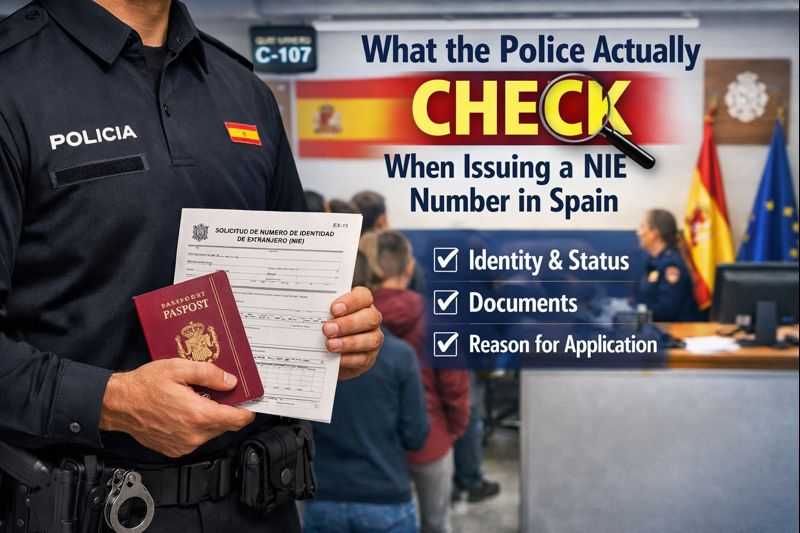
If you’re applying for a NIE number in Spain, one of the most common fears people have is:
“What exactly are the police checking about me?”
Some applicants worry about:
- Criminal records
- Immigration history
- Tax issues
- Previous overstays
- Or whether applying for a NIE somehow “alerts” the authorities
The reality is far more straightforward — and much less intimidating — than most people imagine.
This guide explains exactly what the police do and do not check when issuing a NIE, based on how the process actually works inside Spanish police stations.
What a NIE Really Is (And Why That Matters)
Before understanding the checks, it’s important to understand what a NIE is not.
A NIE (Número de Identidad de Extranjero) is:
- A personal identification number
- Assigned to a foreign national for administrative and legal purposes
- Permanent and unique to you
It is not:
- A residence permit
- A visa
- Proof of legal stay
- A work authorisation
This distinction matters because the checks are limited to the purpose of issuing an ID number, not assessing your life history.
Who Issues NIE Numbers in Spain?
NIE numbers are issued by:
- Policía Nacional (most common)
- Spanish consulates abroad (in limited cases)
Despite the name, this is an administrative function, not a criminal or investigative one.
You are not being “investigated” simply by requesting a NIE.
The Purpose of Police Checks for a NIE
When you attend your NIE appointment, the police are checking one thing above all else:
Does this person have a legitimate legal reason to be assigned a NIE number?
That’s it.
Everything else supports that question.
What the Police ACTUALLY Check When Issuing a NIE
Let’s break it down clearly and honestly.
1. Your Identity (The Most Important Check)
This is the primary check.
The police verify:
- Your passport is genuine
- Your identity matches the passport
- Your name, nationality, date of birth, and passport number are correct
They do not:
- Judge you
- Analyse your background
- Run lifestyle checks
They simply confirm you are who you say you are.
Common reasons for delays here
- Passport about to expire
- Passport damaged
- Name inconsistencies between documents
This is one of the biggest reasons applications fail — and one of the easiest to avoid.
2. Your Reason for Needing a NIE
You must state a reason for requesting a NIE.
Typical acceptable reasons include:
- Buying or selling property
- Inheriting assets in Spain
- Working or becoming autónomo
- Registering a business
- Opening certain bank accounts
- Paying taxes
- Applying for residency later
The police check:
- That your reason is valid under Spanish law
- That it is specific, not vague
- That it makes sense for your situation
They do not:
- Decide whether your plans are “good” or “bad”
- Require you to already live in Spain
- Expect you to speak Spanish fluently
3. Supporting Documents (Only What’s Relevant)
The police only check documents related to your stated reason.
Examples:
- Property reservation contract
- Deeds (escritura)
- Inheritance paperwork
- Employment contract or job offer
- Business registration intent
They do not:
- Ask for unrelated paperwork
- Request bank statements unless strictly relevant
- Investigate your finances beyond necessity
This is why submitting too much paperwork can actually slow things down.
4. Your Application Form (EX-15)
The EX-15 form is checked for:
- Accuracy
- Completeness
- Consistency with your passport
Common mistakes include:
- Wrong NIE request type
- Incomplete addresses
- Inconsistent spelling of names
These errors cause instant rejection or resubmission.
5. Proof of Fee Payment (Modelo 790)
The police confirm:
- The correct fee was paid
- The correct form was used
- Payment matches your application
If the fee is wrong or unpaid:
- Your application will not proceed
- Even if everything else is perfect
What the Police Do NOT Check When Issuing a NIE
This is where many myths exist.
❌ Criminal Records (Usually Not Checked)
For a basic NIE number, the police do not:
- Run international criminal background checks
- Request police certificates
- Search foreign conviction databases
Criminal record checks apply to:
- Residency applications
- Long-term visas
- TIE cards
Not standard NIE issuance.
❌ Immigration Overstay History (Usually Not Relevant)
Applying for a NIE does not automatically trigger:
- Overstay investigations
- Deportation reviews
- Visa compliance checks
A NIE can be issued even if:
- You are a non-resident
- You plan to leave Spain
- You are applying for future legal processes
❌ Tax Compliance Checks
The police do not:
- Check whether you owe Spanish taxes
- Contact the Agencia Tributaria
- Review your income
Tax matters come after a NIE is issued — and are handled by tax authorities, not police.
❌ Bank Account or Financial Status (Most Cases)
Unless your stated reason requires proof of funds, the police:
- Do not request bank balances
- Do not analyse financial history
- Do not assess wealth
❌ Employment History (Unless Relevant)
If you are not applying for a NIE for work:
- Your job history is irrelevant
- Your profession is irrelevant
- Your employment status is irrelevant
Why Some NIE Applications Get Rejected Anyway
Rejections are almost always administrative, not personal.
Top reasons:
- Invalid or vague reason
- Incorrect form completion
- Missing fee payment
- Appointment booked under wrong category
- Inconsistent documents
Very rarely is a rejection due to anything “about you” as a person.
Does Applying for a NIE Put You “On the System”?
Yes — but not in the way people fear.
Your NIE:
- Creates a legal administrative record
- Allows future interactions with Spanish authorities
- Does not flag you negatively
This is normal, necessary, and unavoidable for any legal process in Spain.
How MyNIE Helps Avoid Police Rejection
At MyNIE, the goal is simple:
Submit an application the police can approve without questions.
We help by:
- Ensuring the correct legal reason is used
- Completing forms exactly as expected
- Matching documents to police requirements
- Avoiding common red-flag mistakes
That’s why many applicants succeed on their first attempt, even if they don’t speak Spanish or live in Spain.
Frequently Asked Questions (FAQs)
Do the police check criminal records for a NIE?
No. Criminal record checks apply to residency or visa processes, not basic NIE issuance.
Can I be refused a NIE because of past overstays?
In most cases, no. NIE issuance is administrative, not immigration enforcement.
Do police contact my home country authorities?
No. There is no international background verification for standard NIE applications.
Will the police ask about my income?
Only if your stated reason legally requires proof of funds — otherwise, no.
Is applying for a NIE risky?
No. It is a routine administrative process used by millions of foreign nationals.
Can I apply even if I don’t live in Spain?
Yes. Many NIE applicants are non-residents.
Does a NIE give me residency rights?
No. A NIE is an identification number, not residency permission.
Can I apply again if rejected?
Yes — and rejections are usually easy to fix once the mistake is identified.
Is the police appointment stressful?
Usually no. Appointments are brief, procedural, and professional.
Can MyNIE help even if I’m abroad?
Yes. We assist applicants worldwide.
Final Thoughts: The Reality Is Simpler Than the Fear
The police are not judging you.
They are not investigating you.
They are not deciding your future in Spain.
They are simply asking:
“Is there a legal reason to assign this person a NIE number?”
If the paperwork answers that clearly, the NIE is issued.
And that’s exactly what this process is designed to do.
NIE Numbers in Other Spanish Cities
- How to Get a NIE Number in Málaga
- How to Get a NIE Number in Barcelona
- How to Get a NIE Number in Madrid
- How to Get a NIE Number in Benidorm
- How to Get a NIE Number in Alicante
TIE Card & Residency Help (UK & Non-EU Citizens)
- TIE Card Spain – Full Guide for UK & Non-EU Citizens
- Brexit TIE Card Renewal & Replacement
- Difference Between NIE, TIE, NIF and Green Card
Official Spanish Government Resources