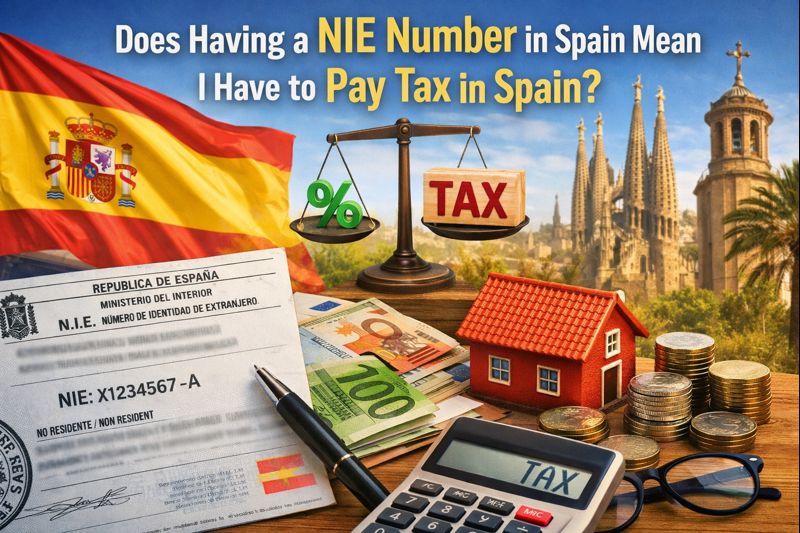
One of the most common questions asked by foreigners in Spain is whether simply having a NIE number means they are required to pay tax in Spain. This concern is especially common among property owners, second-home owners, remote workers, retirees, and people who live part-time in Spain.
The short answer is no:
having a NIE number does not automatically mean you have to pay tax in Spain.
However, the longer answer depends on tax residency, time spent in Spain, and whether you earn Spanish-source income or own assets in Spain. This article explains the rules clearly and accurately, using official Spanish tax guidance, so you can understand when tax obligations apply — and when they do not.
What Is a NIE Number?
A NIE (Número de Identidad de Extranjero) is a personal identification number assigned to non-Spanish nationals who have dealings with Spanish authorities. It is used for administrative and legal purposes such as:
- Buying or selling property
- Opening a Spanish bank account
- Paying taxes or fees
- Working or setting up a business
- Applying for residency
- Signing contracts
A NIE is not proof of residence and not proof of tax residency. It is simply an identification number that stays with you for life.
Spanish government guidance confirms that holding a NIE does not grant residency rights and does not in itself create tax obligations.
Does Having a NIE Automatically Make Me Tax Resident in Spain?
No.
Spanish tax residency is not determined by whether you have a NIE. It is determined by your personal circumstances, primarily:
- How long you spend in Spain
- Where your main economic interests are
- In some cases, where your close family lives
You can have a NIE and be:
- A tourist
- A non-resident property owner
- A non-resident landlord
- A Spanish tax resident
The NIE itself does not decide your tax status. Click here to visit the Spanish tax agency website.
How Does Spain Decide Who Is Tax Resident?
Spain considers you tax resident if any of the following apply during a calendar year (1 January to 31 December):
1. The 183-Day Rule
You spend more than 183 days in Spain in a calendar year.
Short trips abroad may still count as days in Spain unless you can prove tax residence in another country.
2. Centre of Economic Interests
Your main base of economic or professional activity is in Spain. This may include:
- Running a business from Spain
- Managing a company from Spain
- Earning most of your income in Spain
You can be considered tax resident even if you spend fewer than 183 days in Spain if this test applies.
3. Family Circumstances (Presumption)
If your spouse and dependent children normally live in Spain, the Spanish Tax Agency may presume you are resident unless you can prove otherwise.
What Happens If You Are Spanish Tax Resident?
If you are tax resident in Spain, you are generally required to declare worldwide income in Spain. This may include:
- Employment income
- Self-employment income
- Pensions
- Rental income
- Dividends and interest
- Overseas income
Spain has double taxation treaties with many countries (including the UK), which usually prevent the same income from being taxed twice, but declaration obligations still apply.
What If You Are Not Tax Resident in Spain?
If you are not tax resident, you are normally taxed in Spain only on Spanish-source income or assets.
Common examples include:
- Owning a property in Spain
- Renting out a Spanish property
- Selling Spanish property
- Working physically in Spain
- Earning Spanish business income
Non-residents are generally taxed under Non-Resident Income Tax (IRNR) rather than the resident income tax system.
I Have a NIE but Live in Another Country — Do I Pay Spanish Tax?
Not automatically.
If you live outside Spain and are not tax resident, you do not pay Spanish tax on foreign income. However, you maystill have Spanish tax obligations if you:
Own Property in Spain
Non-resident property owners may be required to declare:
- Rental income (if rented)
- Imputed income (if not rented)
Rent Out a Spanish Property
Rental income from Spanish property is considered Spanish-source income and is taxable in Spain for non-residents.
Sell a Spanish Property
Capital gains on Spanish property sales are taxable in Spain, even for non-residents.
These obligations are commonly declared using Modelo 210.
Does Applying for Residency Automatically Mean I Pay Tax?
No.
Immigration status and tax residency are separate legal concepts. Applying for or holding a residency certificate or card does not automatically make you tax resident.
Tax residency depends on:
- Days spent in Spain
- Economic activity
- Personal circumstances
That said, people who live permanently in Spain usually become tax resident in practice.
The Importance of the UK–Spain Double Tax Treaty
If both Spain and another country (such as the UK) could treat you as resident under their domestic laws, the double tax treaty between the two countries applies “tie-breaker rules”.
These typically look at:
- Where you have a permanent home
- Where your centre of vital interests is
- Where you habitually live
- Nationality
This helps determine treaty residence, but does not remove all filing obligations automatically.
Common Scenarios Explained
I got a NIE to buy a holiday home
You are not automatically tax resident, but you may need to file non-resident property tax declarations.
I spend 4–5 months a year in Spain
You may still be non-resident, but economic interests matter.
I work remotely while in Spain
If your work is effectively carried out from Spain, residency risk increases.
My family lives in Spain but I work abroad
This can create tax residency presumption issues.
What Should You Do If You’re Unsure?
- Keep records of days spent in Spain
- Keep evidence of tax residence elsewhere
- Understand your income sources
- Check whether you need to file non-resident declarations
- Get professional tax advice for complex cases
Administrative services such as MyNie can assist with NIE-related issues, appointments, and documentation, helping prevent administrative problems that can later lead to tax complications.
Frequently Asked Questions (FAQs)
Does having a NIE automatically make me tax resident in Spain?
No. A NIE is an identification number only and does not determine tax residency.
If I have a NIE and live abroad, do I have to pay Spanish tax?
Only if you have Spanish-source income or assets that create a tax obligation.
I own a property in Spain but don’t rent it out — do I pay tax?
Possibly. Non-residents may be taxed on imputed income for urban property.
What is Modelo 210?
Modelo 210 is a tax form used by non-residents to declare certain Spanish-source income, commonly related to property.
If I spend more than 183 days in Spain, do I become tax resident?
In most cases, yes — but other factors such as economic interests can also apply.
Does having a residency card automatically mean I pay tax?
No. Tax residency depends on tax rules, not immigration documents.
Key Takeaway
A NIE number alone does not mean you have to pay tax in Spain.
Tax obligations depend on residency status, time spent in Spain, and Spanish-source income or assets.
Understanding the difference can help you avoid unnecessary stress, missed filings, and costly mistakes.
Helpful NIE & Residency Guides
- How to Get a NIE Number in Spain (Complete Guide)
- How Long Does It Take to Get a NIE Number in Spain?
- Urgent NIE Number Spain – What Are Your Options?
- White NIE Certificate vs Green EU Certificate Explained
- EX-15, EX-18 and Form 790 Explained (With English Translations)
NIE Numbers in Other Spanish Cities
- How to Get a NIE Number in Málaga
- How to Get a NIE Number in Barcelona
- How to Get a NIE Number in Madrid
- How to Get a NIE Number in Benidorm
- How to Get a NIE Number in Alicante
TIE Card & Residency Help (UK & Non-EU Citizens)
- TIE Card Spain – Full Guide for UK & Non-EU Citizens
- Brexit TIE Card Renewal & Replacement
- Difference Between NIE, TIE, NIF and Green Card
