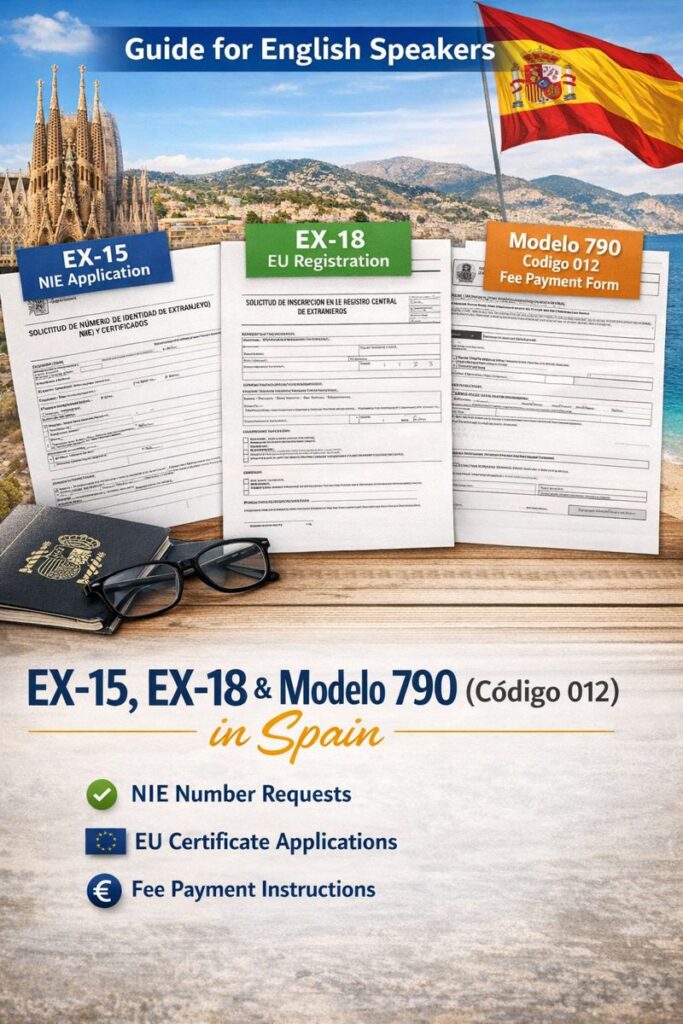
If you’re British (or any English speaker) dealing with Spanish immigration paperwork, these three documents come up constantly:
EX-15 = requesting/confirming your NIE or related certificates
EX-18= applying for the EU Registration Certificate (the “green card” for EU/EEA/Swiss citizens)
Modelo 790 (Código 012) = the fee form you generate and pay for many immigration/police procedures (including NIE assignment and EU registration) via Policía Nacional
Important for UK citizens: most UK nationals living in Spain post-Brexit don’t use EX-18 for residency (that’s for EU/EEA/Swiss). UK nationals typically deal with TIE / Withdrawal Agreement routes instead. However, UK citizens still often use EX-15 (NIE assignment / certificates) and Modelo 790 for fees.
1) What each form is for (in plain English)
EX-15 = “NIE & Certificates request”
Official title: “Solicitud de Número de Identidad de Extranjero (NIE) y Certificados”
You use EX-15 when you need:
a NIE number assigned (if you don’t have one yet), or
a certificate (resident / non-resident certificate), depending on what the office requests.
EX-18 = “EU registration (green certificate)”
Official title: “Solicitud de inscripción en el Registro Central de Extranjeros – Residencia ciudadano de la UE”
You use EX-18 if you are:
an EU/EEA/Swiss citizen staying in Spain more than 3 months and registering for the EU certificate.
Modelo 790 (Código 012) = “Fee / tax form”
You generate it online, choose the exact procedure, and pay the fee (bank or other allowed methods). It includes options such as:
Asignación de NIE a instancia del interesado (NIE assignment at the applicant’s request)
Certificados o informes emitidos a instancia del interesado (certificates/reports)
and many TIE/residency card fee categories
2) Before you start: the rules that catch people out
These instructions appear on both EX-15 and EX-18:
Write in CAPITAL LETTERS (block capitals)
Black pen or typed
Dates use dd/mm/yyyy (day/month/year)
Also:
Bring original + copy of the forms (common requirement stated in form instructions).
3) EX-15: field-by-field English translation + how to fill it
Source: EX-15 official form from Ministerio de Inclusión, Seguridad Social y Migraciones
Section 1) DATOS DEL EXTRANJERO/A = “FOREIGN APPLICANT’S DETAILS”
PASAPORTE = Passport number
N.I.E. = NIE number (leave blank if you don’t have one yet)
1er Apellido = First surname (family name 1)
2º Apellido = Second surname (many UK people leave blank)
Nombre = First name / given name(s)
Sexo (1) = Sex (H = male / M = female / X = indeterminate if officially recognised)
Fecha de nacimiento (2) = Date of birth (dd/mm/yyyy)
Lugar / País = Place / Country of birth
Nacionalidad = Nationality
Estado civil (3) = Marital status:
S Soltero = Single
C Casado = Married
V Viudo = Widowed
D Divorciado = Divorced
Sp Separado = Separated
Nombre del padre / Nombre de la madre = Father’s name / Mother’s name
Domicilio de residencia = Home address (where you live)
Nº / Piso = Number / Floor
Localidad = Town/City
C.P. = Postcode (Código Postal)
Provincia = Province
Teléfono móvil = Mobile phone
E-mail = Email
Representante legal, en su caso = Legal representative (if applicable)
DNI/NIE/PAS = Their ID (Spanish ID / NIE / Passport)
Título (4) = Capacity/title (e.g., parent/guardian)
How most UK applicants fill Section 1
Use your passport number
Put your surname in “1er Apellido”
Leave “2º Apellido” blank
Use a Spanish address if you have one, otherwise the address you’re using for notifications (see Section 3).
Section 2) DATOS DEL REPRESENTANTE A EFECTOS DE PRESENTACIÓN = “REPRESENTATIVE SUBMITTING THE APPLICATION (IF NOT YOU)”
This is only for when someone else files it for you (lawyer/representative). The form says it’s only filled if the presenter is different from the applicant.
Key fields:
Nombre/Razón Social = Name / Company name
DNI/NIE/PAS = Their ID number
Domicilio / Localidad / C.P. / Provincia = Their address details
Teléfono móvil / E-mail = Contact details
Section 3) DOMICILIO A EFECTOS DE NOTIFICACIONES = “ADDRESS FOR OFFICIAL NOTIFICATIONS”
This is where Spain sends updates/letters.
Nombre/Razón Social = Name/company to receive notifications
DNI/NIE/PAS = Their ID (if it’s not you)
Domicilio / Localidad / C.P. / Provincia = Notification address
Teléfono móvil / E-mail = Used for alerts (helpful)
□ CONSIENTO… Dehú / cl@ve = Consent to receive notifications electronically via the official electronic notification channel (Dehú), which requires a digital certificate or Cl@ve.
Simple approach: if you’re not set up for Spanish digital ID systems, many people leave the electronic-consent box unticked and rely on the address + email/mobile fields.
Section 4) DATOS RELATIVOS A LA SOLICITUD = “DETAILS OF WHAT YOU ARE APPLYING FOR”
4.1 TIPO DE DOCUMENTO = “Type of document”
□ NÚMERO DE IDENTIDAD DE EXTRANJERO (NIE) = NIE number (assignment)
Residencia continuada en España durante 5 años = Continuous legal residence in Spain for 5 years
Plus several worker/retirement/incapacity scenarios
Also:
MODIFICACIÓN = Modification (change personal data/address/passport etc.)
BAJA POR CESE = Deregistration / cancellation (rare)
Signatures:
FIRMA DEL SOLICITANTE = Applicant signature
Some cases also mention FIRMA DEL CIUDADANO DE LA UNIÓN (familiar del solicitante) = EU citizen’s signature if the applicant is their family member.
5) Modelo 790 Código 012: English guide + translations (the fee form)
Source: online generator on the Sede Electrónica de la Policía Nacional
You normally do not fill this by hand. You generate it online, choose the procedure, then download/print.
IDENTIFICACIÓN = “Identification”
N.I.F./N.I.E. (*) = Your tax/NIE number
If you don’t have NIE yet, the system may accept another identifier in some contexts, but commonly you’ll use passport details where allowed and/or proceed as your office instructs. (Rules vary by procedure/office.)
Apellidos y nombre o razón social (*) = Surname(s) + first name, or company name
Domicilio = Address
Tipo de vía (*) = Street type (Calle, Avenida, Plaza, etc.)
Principal / Complementaria = Main payment / Additional payment (almost always Principal)
Choose the correct procedure (this is the most important bit)
Under the list, look for the relevant line, for example:
“Asignación de Número de Identidad de Extranjero (NIE) a instancia del interesado.” = “Assignment of NIE number at the applicant’s request.”
“Certificados o informes emitidos a instancia del interesado.” = “Certificates/reports issued at the applicant’s request.”
For EU registration certificate, the police guidance page lists EX-18 plus proof of payment of the 790 012 fee.
DECLARANTE = “Declarant”
Localidad (*) = Town/City (often auto-filled or you type it)
Fecha (*) = Date
INGRESO = “Payment”
Importe euros = Amount in euros (the form calculates based on the procedure)
Forma de pago = Payment method:
En efectivo = Cash
Adeudo en cuenta = Direct debit
(Other options may appear depending on the screen/configuration)
6) Quick “which one do I need?” cheat sheet
I just need an NIE number for property, inheritance, banking, work contract, etc. → EX-15 + Modelo 790 (012) (usually the “Asignación de NIE…” line)
I’m an EU citizen moving to Spain (over 3 months) and need the green EU certificate → EX-18 + Modelo 790 (012)
I’m paying for a certificate/report → Modelo 790 (012) with the “Certificados o informes…” line
FAQs
Do I need to complete EX-15 and Modelo 790?
In many common NIE/certificate cases, yes: EX-15 is the request, and Modelo 790 (012) is the fee form that matches your procedure.
Can I write the forms in English?
The fields are Spanish, and offices generally expect the form completed properly (often in Spanish). Names/addresses can be in the normal format, but your “Motivos / Especificar” is usually safest in simple Spanish.
What date format does Spain use on these forms?
dd/mm/yyyy (day first). It’s explicitly stated in the instructions on both EX-15 and EX-18.
What does “Estancia” vs “Residencia” mean on EX-15?
Estancia = you’re in Spain as a visitor / short stay status
Residencia = you live in Spain as a resident You tick the one that matches your real situation.
Obtaining a NIE Number (Número de Identidad de Extranjero) is one of the most important—and often most frustrating—steps for anyone moving to, investing in, or doing business in Spain. In 2026, despite digitalisation improvements, long delays, unavailable appointments, and regional backlogs continue to make the process slow and confusing for individuals applying on their own.
This is exactly why more people than ever are choosing MyNIE—a specialist service designed to make getting a NIE faster, smoother, and stress-free, even during peak demand periods.
This article explains why MyNIE is the fastest way to get a NIE number in Spain in 2026, how the process works, and why doing it alone often leads to costly delays.
What Is a NIE Number and Why Speed Matters in 2026
A NIE number is required for almost all legal and administrative activities in Spain, including:
Buying or selling property
Opening a Spanish bank account
Starting work or a business
Paying taxes
Inheriting assets
Buying a car
Applying for residency or visas
In 2026, speed matters more than ever. Spanish authorities continue to experience:
Appointment shortages
Regional processing delays
Increased demand from non-EU nationals
Post-Brexit administrative pressure
Seasonal backlogs (spring and summer especially)
Without a NIE, entire transactions can be frozen, including property purchases and employment contracts.
Why Getting a NIE on Your Own Is Often Slow
Many applicants assume they can “just book an appointment online.” In reality, the DIY route frequently causes weeks—or months—of delay.
Common Problems in 2026
Appointments released randomly and disappear within minutes
Websites that crash or show no availability
Incorrect form completion (EX-15 / EX-18 errors)
Wrong police station or province selected
Missing supporting documents
Language barriers during appointments
Even a small mistake can mean starting again from zero.
What Makes MyNIE the Fastest NIE Service in Spain?
MyNIE is not just a form-filling service. It is a specialist NIE appointment and processing service built entirely around speed, accuracy, and success.
1. Faster Access to Appointments
MyNIE constantly monitors appointment systems across Spain and secures the earliest available appointments based on your situation.
This avoids:
Endless refreshing
Missed slots
Booking in the wrong province
2. Correct Documentation the First Time
Incorrect paperwork is the number one cause of delays.
MyNIE ensures:
Correct NIE application forms
Proper justification for your NIE request
Correct payment of Modelo 790 fees
Documents prepared exactly as required in 2026
This dramatically reduces rejection and resubmission delays.
NIE Without Long Delays – Even in High-Demand Areas
In popular regions such as Alicante, Valencia, Málaga, Barcelona, Madrid, and the Balearic Islands, NIE delays can stretch for months when applying alone.
MyNIE helps applicants:
Navigate regional differences
Avoid oversubscribed offices
Choose legally acceptable alternatives when available
This flexibility is a major reason MyNIE applications are processed faster than self-managed ones.
Ideal for Urgent NIE Applications in 2026
Many people need a NIE urgently, for example:
Property purchase deadlines
Mortgage approvals
Job start dates
Notary appointments
Tax deadlines
MyNIE specialises in urgent and time-sensitive cases, helping clients avoid financial penalties, lost deposits, or cancelled transactions.
MyNIE vs Applying Alone: Speed Comparison
Method
Typical Timeframe
Risk Level
Applying Alone
4–12+ weeks
High
Using MyNIE
Often significantly faster
Low
While no service can legally “skip” Spanish procedures, expert handling dramatically shortens the real-world timeline.
Expertise That Saves Weeks, Not Days
Speed is not just about appointments—it’s about experience.
MyNIE understands:
Which reasons are accepted for NIE issuance
How requirements differ between provinces
Current 2026 procedural updates
What police offices actually enforce vs publish
This insider knowledge prevents delays that most applicants don’t even realise exist until it’s too late.
Who Uses MyNIE in 2026?
MyNIE is trusted by:
Property buyers
UK citizens post-Brexit
Non-EU nationals
Digital nomads
Investors
Retirees
Business owners
Students
If your time matters, MyNIE is designed for you.
Transparency, Compliance, and Legal Safety
Unlike informal “fixers,” MyNIE operates fully within Spanish law, ensuring:
No fraudulent shortcuts
No illegal representations
No risky documentation practices
This protects your future applications, residency options, and legal status in Spain.
Why 2026 Is the Worst Year to Delay Your NIE
With increasing migration, investment, and administrative demand, NIE processing is not getting faster on its own.
Delaying or attempting a DIY approach often results in:
Missed opportunities
Lost money
Repeated appointments
Rising stress
Using a professional service from the start is now the fastest and safest strategy.
How the MyNIE Process Works
Submit your details online
Receive clear document instructions
MyNIE secures the best available appointment
Paperwork is prepared correctly
You attend your appointment fully prepared
NIE issued with minimal delay
Simple. Efficient. Proven.
Final Thoughts: The Fastest Way to Get a NIE in Spain in 2026
In 2026, the fastest way to get a NIE number in Spain is not guessing, refreshing government websites, or risking paperwork errors.
It is choosing a specialist service that understands the system, the regions, and the reality of Spanish bureaucracy.
MyNIE exists to save time, reduce risk, and deliver results.
If your NIE matters—and your time does too—MyNIE is the fastest route forward.
Frequently Asked Questions (FAQs)
Is MyNIE legal?
Yes. MyNIE works fully within Spanish legal and administrative frameworks.
Can MyNIE guarantee a NIE?
No one can legally guarantee approval, but MyNIE significantly increases success and speed by avoiding mistakes.
Is MyNIE faster than applying myself?
In most cases, yes—often weeks faster.
Does MyNIE help UK citizens after Brexit?
Yes. Post-Brexit applications are one of MyNIE’s core specialities.
Can MyNIE help with urgent NIE requests?
Yes. Urgent and time-sensitive cases are a key focus.
If you are an EU citizen planning to work or live in Spain, one of the first questions you are likely to ask is whether you need a NIE Number. The short answer is yes – in most cases, you do.
While EU citizens benefit from freedom of movement within the European Union, Spain still requires administrative identification for employment, taxation, banking, and residency matters. This is where the NIE (Número de Identidad de Extranjero) comes in.
This guide explains when an EU citizen needs a NIE Number, how it differs from residency registration, and why it is essential for working and living legally in Spain.
What Is a NIE Number?
A NIE Number is a personal identification number for foreigners in Spain. It is unique, permanent, and issued by the Spanish authorities.
Unlike a residency card, the NIE:
Does not expire
Is assigned once for life
Is used for all legal, financial, and administrative procedures
Even EU citizens who are not permanent residents often require a NIE to interact with Spanish institutions.
Do EU Citizens Need a NIE Number to Work in Spain?
Yes. If you are an EU citizen and want to work in Spain, you will need a NIE Number.
Why a NIE Is Required for Employment
Employers in Spain are legally required to:
Register you with Social Security
Process employment contracts
Report income to the Spanish tax authorities
All of these steps require a NIE Number. Without it:
You cannot be added to payroll
You cannot pay social security contributions
You cannot be legally employed
This applies whether you are:
Employed by a Spanish company
Self-employed (autónomo)
Working on a fixed-term or permanent contract
Do EU Citizens Need a NIE Number to Live in Spain?
Yes. Living in Spain for more than a short stay almost always requires a NIE Number, even if you are not working.
You will need a NIE to:
Rent or buy property
Open a Spanish bank account
Register with local authorities (padrón)
Pay utilities and taxes
Access healthcare and social services
Even EU citizens who are financially independent or retired usually need a NIE to manage daily life in Spain.
NIE Number vs EU Registration Certificate (Green Certificate)
This is one of the most common points of confusion.
NIE Number
Identification number only
Assigned to all foreigners
Required for work, tax, banking, and legal processes
EU Registration Certificate (Certificado de Registro de Ciudadano de la Unión)
Often called the green residency certificate
Required if you stay in Spain longer than 90 days
Confirms your right of residence as an EU citizen
Displays your NIE Number on the certificate
Important: You can have a NIE without being registered as a resident, but you cannot register as a resident without first having a NIE.
When Do EU Citizens NOT Need a NIE?
In very limited situations, a NIE may not be required, such as:
Short tourist stays under 90 days
No financial, legal, or administrative activity in Spain
However, the moment you:
Accept employment
Sign a rental contract
Buy property
Open a bank account
A NIE Number becomes mandatory.
Is a NIE the Same as Tax Residency?
No. Having a NIE does not automatically make you tax resident in Spain.
Tax residency depends on factors such as:
Spending more than 183 days per year in Spain
Having your main economic interests in Spain
Having close family permanently resident in Spain
You can hold a NIE without owing Spanish tax, provided you do not meet the tax residency criteria.
How EU Citizens Can Apply for a NIE Number
EU citizens can apply for a NIE:
In Spain at a police station or immigration office
Via the Spanish consulate in their home country
You will typically need:
A valid EU passport or ID card
Proof of reason for the NIE (work, property, economic interest)
Completed application forms
Payment of the official government fee
Appointments are often difficult to obtain, which is why many EU citizens choose professional assistance.
Why Most EU Citizens Apply for a NIE Before Moving
Applying early avoids:
Delays starting work
Problems opening bank accounts
Missed job opportunities
Last-minute appointment stress
A NIE is often the first administrative step before registering as an EU resident or starting employment.
Frequently Asked Questions (FAQs)
Do EU citizens legally need a NIE to work in Spain?
Yes. A NIE is legally required to register employment, social security, and income tax in Spain.
Can I work in Spain with just my EU passport?
No. While your EU passport gives you the right to work, Spanish systems require a NIE Number to process employment legally.
Do I need a NIE if I am self-employed in Spain?
Yes. Registering as autónomo, invoicing clients, and paying social security all require a NIE Number.
Is the NIE the same as residency?
No. The NIE is an identification number. Residency registration is a separate legal status for EU citizens staying longer than 90 days.
Does a NIE expire?
No. Your NIE Number is permanent and issued for life.
Can I apply for a NIE before moving to Spain?
Yes. Many EU citizens apply in advance to avoid delays when they arrive.
Do EU retirees need a NIE to live in Spain?
Yes. Retired EU citizens usually need a NIE for property, healthcare registration, and financial matters.
Does having a NIE mean I must pay tax in Spain?
No. Tax obligations depend on tax residency rules, not on having a NIE alone.
Final Thoughts
If you are an EU citizen planning to work or live in Spain, a NIE Number is essential. While EU freedom of movement allows you to enter and work legally, Spanish administrative systems require a NIE for almost everything that matters – employment, banking, housing, and taxation.
In practice, you cannot fully work or live in Spain without one.
If you are planning to live, work, buy property, start a business, open a bank account, or stay long-term in Spain, one of the very first things you will need is a NIE Number. This is especially true if you are moving to or spending time on the Costa Blanca, one of Spain’s most popular regions for expats, retirees, property buyers, and digital nomads.
In this comprehensive guide, we explain exactly how to get a NIE Number on the Costa Blanca, including:
What a NIE Number is and why you need one
The difference between a NIE, Green EU Certificate, and TIE
How the NIE process works specifically in Costa Blanca towns
Police stations and appointment systems in Alicante province
Required forms and documents
Common mistakes that cause delays
How long it really takes
How services like MyNIE can help speed things up
Whether you’re heading to Alicante, Benidorm, Torrevieja, Altea, Calpe, or anywhere else along the coast, this guide covers everything you need to know.
What Is a NIE Number?
A NIE Number (Número de Identidad de Extranjero) is a personal identification number issued by the Spanish authorities to foreigners.
Your NIE Number is:
Unique
Permanent (it never changes)
Required for almost all legal and financial activities in Spain
The NIE itself is just a number, but it can appear on different documents depending on your situation.
Important clarification
Many people say “my NIE expired” — this is not correct. Your NIE number never expires. Only the certificate or card it appears on may expire.
Why You Need a NIE Number on the Costa Blanca
You will need a NIE Number if you plan to do any of the following on the Costa Blanca:
Buy or sell property
Rent long-term
Work or become self-employed
Open a Spanish bank account
Register for utilities
Pay taxes
Buy or register a vehicle
Inherit property or assets
Apply for residency
Apply for a TIE card
Start a business
In short: no NIE, no paperwork.
Who Needs a NIE Number?
You need a NIE Number if you are not Spanish and you have economic, legal, or administrative interests in Spain.
This includes:
EU citizens
UK citizens (post-Brexit)
Non-EU nationals
Retirees
Property owners
Employees and freelancers
Students
NIE vs Green EU Certificate vs TIE Card (Important Differences)
Understanding this difference avoids huge confusion.
NIE Number
The number itself
Never expires
Assigned once for life
White NIE Certificate (EX-15)
Paper document with your NIE number
Used for property, banking, or one-off purposes
No residency rights
Common for non-residents
Green EU Certificate (EX-18)
For EU citizens living in Spain
Confirms residency
Green credit-card sized document
Includes NIE number
TIE Card
For non-EU residents (including UK citizens post-Brexit)
Plastic biometric card
Requires residency approval first
NIE number printed on it
Why the Costa Blanca Is One of the Busiest NIE Regions in Spain
The Costa Blanca attracts hundreds of thousands of foreign residents, especially from:
The UK
Ireland
Germany
Netherlands
Belgium
Scandinavia
As a result, NIE appointments in Alicante province are some of the most requested in Spain.
The good news? Compared to Madrid or Barcelona, appointment availability on the Costa Blanca is often better, if you know where and how to book.
Where to Apply for a NIE Number on the Costa Blanca
NIE applications are handled by:
Policía Nacional
Extranjería offices
Common locations include:
Alicante city
Benidorm
Torrevieja
Elche
Denia
Orihuela Costa
Each office has different appointment availability, which changes constantly.
Step-by-Step: How to Get a NIE Number on the Costa Blanca
Step 1: Identify Which NIE You Need
This depends on your purpose:
Property purchase → White NIE (EX-15)
Work or residence → Green EU Certificate (EX-18) or TIE
Choosing the wrong option causes rejections.
Step 2: Book a Cita Previa (Appointment)
Appointments are booked online through the Spanish government system.
Problems many people face:
No appointments showing
Wrong police station selected
Booking wrong procedure
Website only in Spanish
Appointments released randomly
This is where many applicants fail.
Step 3: Complete the Correct Forms
EX-15 (NIE only)
Used for:
Property
Banking
Legal matters
EX-18 (EU residency)
Used for:
Living and working in Spain (EU citizens)
Form 790 (Tax payment)
Must be paid before the appointment
Paid at a Spanish bank or online
Wrong payment code = rejected application
Step 4: Prepare Supporting Documents
Typically required:
Passport (original + copy)
Completed forms
Proof of reason (property contract, job offer, etc.)
Proof of address (sometimes)
Bank payment receipt (Form 790)
Missing even one document can mean starting again.
Step 5: Attend the Police Appointment
On the day:
Arrive early
Dress appropriately
Bring originals + copies
Be polite and concise
Some offices issue the NIE on the same day, others ask you to return.
How Long Does It Take to Get a NIE Number on the Costa Blanca?
Typical timelines:
Appointment booking: Same day to 2 weeks
Police appointment: 10–30 minutes
NIE issued: Same day to 2 weeks
Delays usually occur due to:
Incorrect paperwork
Wrong appointment type
Missing payment receipt
Language misunderstandings
Common NIE Mistakes on the Costa Blanca
Booking the wrong procedure
Turning up without Form 790 paid
Using outdated forms
Applying in the wrong province
Assuming NIE = residency
Believing appointments are “impossible”
Most of these mistakes are avoidable.
Can You Get a NIE Number Without Living in Spain?
Yes.
You can:
Apply in Spain as a non-resident
Apply via a representative
Apply through a professional service
Many Costa Blanca property buyers do exactly this.
How MyNIE Helps You Get a NIE Number on the Costa Blanca
Services like MyNIE are designed for people who:
Don’t speak Spanish
Want the fastest possible appointment
Want paperwork done correctly
Want clear instructions
Want to avoid costly mistakes
MyNIE can:
Book the correct police appointment
Complete all forms accurately
Advise which Costa Blanca office is fastest
Provide step-by-step instructions
Save weeks of stress
For a low fixed fee, many applicants find this far easier than doing it alone.
Is It Possible to Get an Urgent NIE Number?
In many Costa Blanca locations, yes.
Urgent cases include:
Job start dates
Property completion deadlines
Inheritance matters
Availability depends on location and timing, but urgent bookings are often achievable.
Do You Need a Lawyer or Gestor?
Not necessarily.
A gestor or specialist NIE service is often:
Cheaper
Faster
More focused on NIE applications
Lawyers are usually only needed for complex legal cases.
NIE Appointments After Brexit (UK Citizens)
UK citizens are now non-EU nationals.
This means:
NIE first
Then residency approval
Then TIE card
Many UK citizens still need a NIE only for property or financial matters.
Living on the Costa Blanca Long-Term
If you plan to live on the Costa Blanca permanently, your NIE is just the start.
You may later need:
Residency registration
Padron (town hall registration)
Social security number
Tax registration
But none of this is possible without a NIE number first.
FAQs: NIE Number Costa Blanca
What is a NIE Number?
A unique identification number for foreigners in Spain used for legal and financial matters.
Does a NIE Number expire?
No. The number never expires.
Can I apply without speaking Spanish?
Yes, but professional help makes it much easier.
Is Alicante the best place to apply?
Often yes, but nearby towns may have faster availability.
Can I get a NIE for property only?
Yes, using the EX-15 form.
How much does a NIE cost?
Government fee is low, plus optional service fees if you use help.
Can I apply from the UK?
Yes, but applying in Spain is usually faster.
Can my appointment be rejected?
Yes — usually due to paperwork errors.
Is the Costa Blanca faster than Madrid?
Generally, yes.
Do I need an address in Spain?
Not always, depending on application type.
Final Thoughts
Getting a NIE Number on the Costa Blanca is not complicated, but it is procedural. Most problems arise from incorrect forms, wrong appointments, or misunderstandings.
If you prepare correctly — or use a specialist service — the process can be quick, affordable, and stress-free.
For anyone planning life, work, or property ownership on the Costa Blanca, your NIE Number is the key that unlocks everything else.
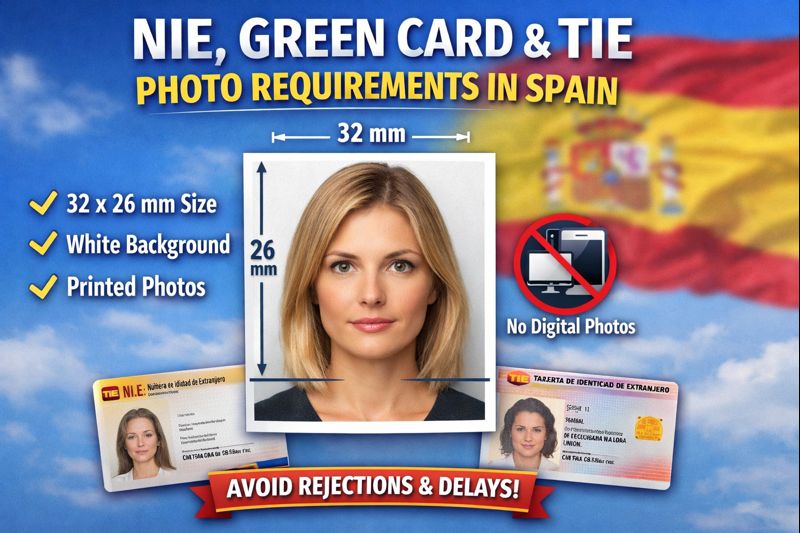
If you’re attending a NIE number,EU green certificate, or TIE card appointment in Spain, one of the most common reasons for delays or rejection is incorrect passport photos.
Spanish immigration offices are very strict about photo size, format, and quality. Turning up with the wrong photos can mean being sent away, losing your appointment, or having to rebook weeks (or even months) later.
In this complete guide, we explain exactly what size photos you need, how many to bring, where to get them taken in Spain, and the most common mistakes people make — so you can attend your appointment fully prepared.
Why Correct Photos Matter for Spanish Immigration Appointments
Unlike some countries where photos are scanned or taken digitally on the day, Spanish police and immigration offices require physical printed photos for most procedures, including:
NIE number applications
EU Green Certificate (Certificado de Registro de Ciudadano de la UE)
TIE cards (including Brexit Article 50 cards)
Residency renewals
Replacement cards
If your photos do not meet the exact specifications, your application can be rejected on the spot.
Official Photo Size for NIE, Green Card & TIE Appointments
✅ Standard Required Photo Size in Spain
The official and universally accepted photo size for NIE, Green Card and TIE appointments is:
📏 32 mm wide × 26 mm high
This is NOT the same as UK passport photos and NOT the same as US passport photos.
Photo Size at a Glance
Width: 26 mm
Height: 32 mm
Colour: Full colour only
Paper: Matte or semi-matte (not glossy)
Background: Plain white
Recency: Taken within the last 6 months
How Many Photos Should You Take?
Although requirements can vary slightly by office, you should always bring at least:
2 identical photos (minimum)
3–4 photos recommended (just in case)
Some offices will keep one photo, others may require two, and occasionally an additional photo is requested for internal records.
👉 Top tip: Extra photos cost very little and can save you from a wasted appointment.
Photo Requirements Explained (Very Important)
Spanish authorities are extremely particular about photo quality. Your photo must meet all of the following conditions:
✅ Background
Plain white background only
No shadows
No patterns
No off-white, cream, or grey tones
✅ Face & Position
Face must be centred
Looking directly at the camera
Neutral facial expression
Mouth closed
Eyes open and visible
✅ Head Size & Cropping
Head should fill around 70–80% of the photo
Top of head fully visible
Chin fully visible
No excessive space above the head
✅ Glasses & Accessories
Glasses are allowed, but:
No glare
No tinted lenses
Eyes must be fully visible
No sunglasses
No hats, caps, or head coverings (unless for religious reasons)
✅ Hair & Clothing
Hair must not cover eyes
Clothing should contrast with the white background
Avoid white tops if possible
Can You Use UK Passport Photos for a NIE or TIE?
❌ No — in most cases
UK passport photos are 35 mm × 45 mm, which is too large and the wrong ratio for Spanish immigration.
Many people are rejected because they assume “passport photo” means the same thing everywhere. In Spain, it does not.
You must bring printed photos that already meet the correct dimensions.
Where to Get Photos Taken in Spain
📍 Photo Booths (Fotomatón)
The easiest and most reliable option in Spain is a photo booth, often found:
In shopping centres
Near police stations
Inside large supermarkets
At transport hubs
These booths usually include a “Foto Carnet” option that automatically prints the correct Spanish size.
📸 Photography Shops
Local photography shops are also an excellent option. Simply say:
“Fotos tamaño carnet para extranjería”
They will know exactly what is required.
🚫 Avoid Online Photo Services
Online photo services are risky unless they specifically guarantee Spanish 32×26 mm photos. Many “passport photo” websites default to UK or EU passport sizes and can cause rejection.
Do Children and Babies Need the Same Photo Size?
✅ Yes
Children, infants, and babies must use the same 32 mm × 26 mm photo size.
However:
Babies do not need to maintain eye contact
Mouth may be slightly open
Head support must not be visible
Common Photo Mistakes That Cause Rejection
Avoid these very common errors:
❌ Wrong size (UK or US passport photos) ❌ Cream or grey background ❌ Glossy photo paper ❌ Photos older than 6 months ❌ Shadows behind the head ❌ Over-cropped or zoomed-out face ❌ Digital or phone photos
Even one small issue can result in your application being refused.
Do All NIE, Green Card and TIE Appointments Use the Same Photo Size?
✅ Yes
The same 32 × 26 mm photo size is used for:
NIE number applications
EU Green Certificates
TIE cards (including Brexit cards)
Renewals and replacements
This standard applies across Spain.
What Happens If You Bring the Wrong Photos?
Depending on the office and staff member, you may:
Be told to leave and return with correct photos
Lose your appointment completely
Have to rebook weeks later
Be refused processing on the day
Given how hard appointments are to secure, this is a risk worth avoiding.
FAQ: NIE, Green Card & TIE Photo Requirements
What size photo do I need for a NIE appointment in Spain?
You need 32 mm × 26 mm printed photos with a white background.
How many photos should I bring to my TIE appointment?
Bring at least two, ideally three or four.
Can I take my own photo at home?
It is not recommended. Most rejections happen with self-taken or online photos.
Are UK passport photos accepted?
No. UK passport photos are the wrong size.
Do children need photos for NIE or TIE cards?
Yes — children and babies require photos in the same format.
Do police stations take photos on the day?
Almost never. You must bring your own photos.
Final Tips to Avoid Problems at Your Appointment
✔ Get photos taken in Spain ✔ Ask for “foto carnet para extranjería” ✔ Bring extra copies ✔ Check size before leaving the shop ✔ Keep photos flat and undamaged
Need Help With Your NIE or TIE Appointment?
Having the correct photos is just one part of a successful application. Many applicants struggle with:
Booking appointments
Correct paperwork
Forms and payment models
Office-specific requirements
Using a professional service can save weeks of stress and avoid costly mistakes.
Summary
Photo size: 32 mm × 26 mm
Background: White
Format: Printed, colour
Quantity: 2–4 photos
Applies to: NIE, Green Card, TIE
Arriving prepared means your appointment is more likely to go smoothly — and the right photos are a small detail that makes a big difference.
Why MyNIE Reviews Are Overwhelmingly Positive (And Why 99% of Customers Are Thrilled)
Introduction: No Service Pleases Everyone — But Ours Pleases Almost Everyone
In any service industry — especially one involving immigration, legal paperwork, and government systems — it is impossible to keep every single customer happy. People are stressed, deadlines are tight, and Spanish bureaucracy can be confusing at the best of times.
That said, at MyNIE, we’re proud to say that around 99% of our customers are genuinely thrilled with the service they receive.
Not “satisfied”. Not “it’ll do”. But relieved, grateful, and happy they didn’t try to navigate the NIE process alone.
This article explains why.
Why Immigration Services Attract Strong Opinions
Applying for a NIE number often happens during stressful life moments:
Buying property in Spain
Moving country after Brexit
Starting a job or business
Dealing with inheritance or legal deadlines
When emotions are high, expectations can be unrealistic. Some people expect:
Instant appointments
Guaranteed police availability
Zero paperwork
Outcomes beyond legal limits
No service — anywhere — can promise that.
What MyNIE does promise is:
Clear guidance
Honest timelines
Correct documentation
Real human support
That’s why the vast majority of customers leave 5-star feedback.
What 5-Star Reviews About MyNIE Consistently Highlight
When we analyse positive feedback, the same themes appear again and again:
1. Clarity Where There Was Confusion
Customers repeatedly mention how lost they felt before using MyNIE — and how relieved they felt afterward.
Spanish government websites are complex, regional, and often contradictory. MyNIE translates that chaos into clear steps.
2. Speed Without False Promises
We never promise the impossible. Instead, we:
Explain realistic timeframes
Prepare applications properly
Prevent rejections and delays
Customers appreciate honesty far more than hype.
3. Calm, Human Reassurance
A recurring theme in reviews is emotional relief:
“I finally slept properly once I knew it was being handled.”
That peace of mind is a huge part of the service.
4. Exceptional Value for Money
Many customers are shocked by how affordable MyNIE is compared to:
A tiny percentage of negative feedback usually comes from:
Missed emails
Unrealistic expectations
External delays (police appointments, system outages)
Customers who didn’t read instructions fully
Ironically, a mix of reviews increases trust. A perfect score with zero criticism looks fake. A service with thousands of happy clients and the odd unhappy one looks real — because it is.
Transparency Is Why Customers Trust MyNIE
We don’t delete criticism. We don’t argue publicly. We don’t make impossible claims.
Instead, we:
Respond professionally
Improve processes
Learn from edge cases
That transparency is a big reason long-term trust keeps growing.
What our Customers say about us….
“I was completely overwhelmed before finding MyNIE — they made everything feel simple.”
“Clear instructions, fast responses, and zero stress.”
“Worth every penny just for the peace of mind.”
“Finally someone who explains Spanish bureaucracy in plain English.”
“I wish I’d found MyNIE sooner.”
“No hidden fees, no pressure, just honest help.”
“They stopped me making mistakes that would have delayed everything.”
“Professional, friendly, and incredibly efficient.”
“The step-by-step guidance was brilliant.”
“Saved me hours of confusion and frustration.”
“I felt supported from start to finish.”
“Straightforward, honest service — exactly what I needed.”
“They responded faster than I expected.”
“Everything was explained clearly, even the tricky bits.”
“Great value compared to using a lawyer.”
“Helped me avoid a rejected application.”
“Calm, reassuring, and professional throughout.”
“Made a stressful situation manageable.”
“Exactly as described — no nonsense.”
“Very impressed with the level of detail.”
“I didn’t feel rushed or ignored.”
“They know the NIE process inside out.”
“Clear timelines and realistic expectations.”
“Simple, efficient, and reliable.”
“The guidance was spot-on.”
“Helped me understand what the police actually require.”
“Polite, patient, and knowledgeable.”
“Removed all the guesswork.”
“Worth it just to avoid mistakes.”
“Felt like having an expert on my side.”
“Everything was organised perfectly.”
“They answered questions I didn’t even know to ask.”
“Helped me feel confident going to my appointment.”
“Professional service without the legal-firm price.”
How to Get a NIE Number in Ibiza (Complete 2026 Guide)
If you’re moving to Ibiza, buying a property, starting a job, setting up autónomo, opening a bank account, or even registering certain official paperwork, you’ll quickly come across the same requirement: a Spanish NIE number.
Your NIE (Número de Identidad de Extranjero) is your foreigner identification number in Spain. It’s not the same as residency, and it’s not a “card” by itself—think of it as an identification reference used by Spanish authorities to link you to tax, legal and administrative processes. In Ibiza (and all of Spain), many everyday “big” life actions require a NIE: property purchase, mortgage paperwork, inheritance, registering utilities, buying a car, starting work, and more.
In this guide you’ll learn:
What a NIE number is (and what it isn’t)
The different types of NIE paperwork people confuse
Exactly how to apply for a NIE number in Ibiza
What documents to prepare, what forms you need, and what the fees are
Tips for getting an appointment (cita previa) and avoiding common mistakes
How www.mynie.co.uk can help make it simpler (and faster) for a low fixed fee
A full FAQ section at the end
What Is a NIE Number?
A NIE number is a unique identification number assigned to foreigners in Spain. It usually starts with a letter (X, Y, or Z) followed by 7 digits and another letter, for example: X1234567A.
The NIE is used for:
Taxes and financial administration
Buying/selling property
Legal paperwork (notary, contracts)
Employment and social security processes
Banking and many official registrations
What the NIE is NOT
A NIE is not automatically residency. Many people get a NIE without becoming residents. Residency is a separate process with different paperwork (for EU citizens it’s often the “green certificate”; for non-EU citizens it’s usually linked to a visa and a TIE card).
That’s why it’s important to apply for the right thing.
NIE vs “White NIE Certificate” vs “Green EU Certificate” vs TIE
People use “NIE” as a catch-all, but there are a few different documents you might hear about:
1) The NIE number itself
This is the number. Once assigned, it stays with you for life (in practice, it doesn’t change).
2) White NIE certificate (often EX-15)
This is a paper certificate showing your NIE number and your details. It’s commonly requested for non-residents who need a NIE for a specific reason (like buying property).
3) Green EU Certificate (EU registration certificate)
If you’re an EU/EEA/Swiss citizen and you’re living in Spain, you may need the EU registration certificate (“green card” style paper). That also shows your NIE, but it’s a residency registration document, not “just a NIE”.
4) TIE card
For non-EU citizens (including many UK citizens post-Brexit), residency is normally evidenced by a TIE card (plastic card). That process usually requires a visa/residency route first.
This article focuses on getting a NIE number in Ibiza, most commonly via the white certificate route, and it also explains where you might need to do something different depending on your situation.
Who Typically Needs a NIE Number in Ibiza?
Ibiza attracts people for work, lifestyle, and property—so there are a few classic scenarios:
Buying a property in Ibiza (house, apartment, land, investment property)
Renting long-term (some contracts and registrations require it)
Starting work (employed or self-employed)
Setting up a Spanish business
Opening a Spanish bank account
Buying a vehicle or registering one in Spain
Inheritance / legal representation
Paying certain taxes / dealing with Agencia Tributaria
If you’re unsure whether you need one yet, it’s usually better to get it before you hit a hard deadline like a notary completion date or a job start date.
Where Do You Apply for a NIE Number in Ibiza?
In most cases, NIE applications are handled by the Policía Nacional (or relevant immigration/foreigner’s office depending on the region and your nationality/status).
In the Balearic Islands, appointments are generally managed through Spain’s official cita previa system. Availability can vary by season—Ibiza can get extremely busy in spring and summer as seasonal work ramps up and people arrive.
Key point: appointment availability is often the biggest bottleneck, not the paperwork itself.
Step-by-Step: How to Get a NIE Number in Ibiza
Below is the most common route for non-residents who need a NIE for a specific reason (property purchase, bank account, etc.). Your exact route can differ depending on whether you are EU/non-EU and whether you are applying for residency at the same time.
Step 1: Identify the correct type of application
Ask yourself:
Do I only need a NIE number for a specific transaction (non-resident)?
Or am I registering as a resident (EU certificate / or non-EU residency/TIE)?
If you’re non-resident and need a NIE for a specific reason, you’re usually looking at the EX-15 / “Asignación de NIE” style application.
Step 2: Book the appointment (Cita Previa)
Spain uses an online appointment system. You choose:
The province/office area
The type of procedure (this is where people often choose the wrong option)
A date/time slot (if available)
Common problem: No appointments showing, especially in peak months. This is one reason many people use a support service—because repeatedly checking and knowing which appointment category to select saves real time.
Step 3: Prepare the documents
In general, you should prepare:
Passport (original + photocopy of photo page)
Application form (commonly EX-15 for NIE assignment)
Proof of why you need the NIE (this is crucial)
Modelo 790 fee form and proof of payment (fee varies; you usually pay at a bank)
Letter from your bank requesting a NIE to open the account
Job offer / employer letter
Legal letter regarding inheritance or representation
Tip: Your reason should be consistent across the form and supporting documents.
Step 4: Pay the NIE fee (Modelo 790)
Most NIE applications require a fee payment using Modelo 790 (often the 790-012). You typically:
Fill out the form
Take it to a bank to pay
Bring the stamped receipt as proof
Very common mistake: People arrive at the appointment without the paid fee receipt (or with the wrong version). That can waste the appointment.
Step 5: Attend your appointment in Ibiza
Bring:
Originals + photocopies
Completed forms
Fee receipt
Any supporting documents for your reason
Any extra ID documents you have (just in case)
At the appointment, the officer will check your paperwork and (if all is correct) process the NIE assignment/certificate request.
Step 6: Receive your NIE certificate (or collection instructions)
Outcomes vary:
Sometimes you receive the certificate in a short timeframe
Sometimes you’re told how/when to collect it
Sometimes you may receive instructions for the next step (depending on your case)
Either way: once you have the NIE number, you can normally proceed with the transaction (banking, notary, etc.).
How Long Does It Take to Get a NIE Number in Ibiza?
There are two different “timeframes” people confuse:
How long to get an appointment (the unpredictable part)
How long for the NIE certificate to be issued after the appointment (often shorter)
In Ibiza, the real issue is frequently appointment availability, especially during the busy season. If you have a deadline (property completion, job start date), don’t leave it late.
Common Mistakes That Cause Delays (And How to Avoid Them)
Choosing the wrong appointment type
Spain’s booking categories can be confusing. If you pick the wrong procedure, you might be turned away.
Missing the proof of “reason”
A NIE is not always granted “just because.” You’re normally expected to justify why you need it.
Incorrect or incomplete forms
Small errors—wrong passport number format, missing signature, wrong box ticked—can delay things.
No photocopies
Many offices expect photocopies. Always bring copies to avoid last-minute stress.
Unpaid fee / wrong fee form
A classic. Have the correct Modelo 790 and the proof of payment.
Inconsistent information
If your reason on the form doesn’t match your supporting documents, it can raise questions.
If you’re dealing with Spanish forms, appointment systems, and administrative rules—often while you’re not yet fully settled in Spain—it can be a headache. That’s where a specialist support service helps.
www.mynie.co.uk offers a straightforward service to help you secure your NIE number appointment and ensure your paperwork is correctly prepared.
What MyNIE.co.uk helps with
Helping you understand which NIE route you need (non-resident NIE vs residency routes)
Preparing your NIE application paperwork correctly
Guiding you through what documents to bring
Helping reduce the risk of common errors that cause delays
Saving you time by making the overall process simpler and clearer
Cost and simplicity
MyNIE is designed to be affordable and transparent. Many customers use it because it avoids the “guesswork” and repeated trial-and-error that can happen with appointments and forms—especially in busy places like Ibiza.
(If you also need residency support or a TIE route, your sister site can help too: TIECardSpain.com.)
Bottom line: If you want to get it done with less stress, MyNIE helps you do it properly the first time—particularly useful if you’re on a deadline.
Ibiza-Specific Tips (Realistic, Practical Advice)
Apply earlier than you think you need to
Ibiza has seasonal spikes. If you’re moving in spring/summer, assume appointments will be tighter.
If it’s for property: align timing with your notary date
Notaries and banks will often ask for NIE details at key points—don’t wait until the last week.
Keep your paperwork “clean”
Spanish admin loves consistency. Use the same name format as your passport. Avoid different spellings across documents.
Bring more documents than you think you need
Even if the checklist says “X”, bringing extra proof can save the day if the officer asks questions.
What If My Name Is Spelled Differently on Some Documents?
This happens a lot, especially with double surnames, middle names, accents, or different transliterations.
General rules:
Use your passport spelling as the “source of truth”
Keep the same format across EX-15 / supporting letters
If a bank or contract uses a different spelling, try to correct it before the appointment (or bring evidence tying the documents to you)
Consistency reduces administrative friction.
Do You Need a NIE If You’re Only Visiting Ibiza?
If you’re purely visiting (holiday, short stay, no official transactions), usually no.
But if you’re doing anything official—signing a long-term rental, buying property, opening accounts, starting work—you’ll likely need it.
FAQs: NIE Number Ibiza
1) Can I get a NIE number in Ibiza if I’m not a resident?
Yes. Many people apply as non-residents because they need a NIE for property purchase, banking, or legal transactions.
2) Is the NIE number the same as residency?
No. A NIE is an identification number. Residency is a separate process. EU citizens may get a green EU certificate; non-EU citizens often need a TIE route.
3) Which form do I need for a NIE number in Ibiza?
For a typical non-resident NIE assignment/certificate, it’s commonly EX-15 (plus the relevant fee form, often Modelo 790-012). Your exact form can vary by purpose.
4) How much does a NIE number cost in Spain?
There is usually an official fee (paid with Modelo 790). The amount can change, and may differ by procedure. On top of that, services like MyNIE.co.uk charge a support fee for helping with bookings and paperwork.
5) Do I need a Spanish address to get a NIE?
Not always, but you may need to provide contact details. Requirements can vary based on your procedure and the office.
6) Can I apply for a NIE number online?
The appointment booking is online, but the NIE process typically requires an in-person appointment (or a formal representative route in some cases).
7) How long does it take to get a NIE in Ibiza?
It depends mainly on appointment availability. After the appointment, processing time is often shorter. In Ibiza, peak season can slow everything down.
8) What documents do I need to bring to the NIE appointment?
Commonly:
Passport original + copy
Completed application form
Proof of the reason for NIE (property, bank, work etc.)
Fee form (Modelo 790) + proof of payment Always bring photocopies.
9) What if there are no appointments available in Ibiza?
This is common at certain times of year. People either keep checking frequently, consider nearby availability where permitted, or use a service that helps reduce the trial-and-error.
10) Can MyNIE.co.uk help if I’m outside Spain?
Yes—many people start the process while still in the UK or elsewhere. The key is having everything prepared so you can attend the appointment correctly.
11) Do UK citizens need a NIE in Ibiza?
Yes—if you’re doing official transactions (property, work, bank accounts, residency routes, etc.). Since Brexit, the residency route may differ, but the need for a NIE remains common.
12) Is the NIE number permanent?
Generally, yes. Once assigned, it’s linked to you long-term.
13) What if I need a TIE card as well?
A TIE is a different process linked to non-EU residency status. If you need help with that side, your sister site TIECardSpain.com is relevant.
14) Can I buy property in Ibiza without a NIE?
In practice, you’ll almost always need a NIE to complete property purchase and related tax steps. Get it as early as possible.
15) What’s the easiest way to avoid mistakes?
Have the correct appointment type, correct forms, correct fee payment proof, and consistent supporting documents. That’s exactly what services like MyNIE.co.uk help with.
Losing your NIE number in Spain can feel stressful, especially if you rely on it for work, residency, property ownership, banking, or healthcare. Many people worry that losing their NIE means losing their legal status — but the good news is this: your NIE number is permanent and never expires.
Even if you lose your physical document, your NIE itself remains valid for life.
This comprehensive guide explains exactly what to do if you lose your NIE number, how to recover it, how to replace lost documents, and how to avoid common mistakes. Whether you had a simple NIE certificate, a green residency card, or a TIE card, this article walks you through every scenario step by step.
What Is an NIE Number?
An NIE (Número de Identidad de Extranjero) is a unique personal identification number issued to foreigners in Spain. It is used in almost all official, legal, and financial matters, including:
Buying or selling property
Opening a Spanish bank account
Paying taxes
Registering for healthcare
Working or becoming self-employed
Applying for residency
Buying or registering a vehicle
The NIE follows the format:
Letter – 7 numbers – Letter Example: X1234567A
Important: Your NIE Is for Life
Once assigned, your NIE never changes, even if:
Your residency expires
You leave Spain for years
You lose your documents
You change nationality
What may expire is the document that shows your NIE, not the number itself.
What Does “Losing Your NIE” Actually Mean?
When people say they’ve “lost their NIE,” they usually mean one of the following:
They lost their white NIE certificate
They lost their green EU residency card
They lost their TIE card
They don’t remember their NIE number at all
Their documents were stolen
Their NIE paperwork was damaged
Each situation has a different solution, which is why it’s important to identify exactly what you lost.
Step 1: Work Out What You Have Lost
Scenario 1: You Lost the NIE Certificate (White Paper)
This is common for non-residents or people who applied for an NIE for property or financial reasons.
Your NIE number still exists
You can request a duplicate certificate
You do not need a new NIE
Scenario 2: You Lost Your Green EU Residency Card
EU citizens receive a green A4 certificate or plastic card confirming residency.
Your NIE remains valid
You can request a replacement certificate
No new NIE is issued
Scenario 3: You Lost Your TIE Card
Non-EU residents (including UK citizens post-Brexit) receive a TIE card.
The NIE is permanent
The card must be officially replaced
A police report is usually required
Step 2: Check If You Already Have Your NIE Number
Before starting a replacement process, try to recover your NIE number from existing records.
Your NIE may appear on:
Old property deeds (escritura)
Bank statements
Tax documents
Employment contracts
Payslips
Utility bills
Previous residency paperwork
Notary documents
Emails from lawyers or gestors
If you find the number, you may only need a duplicate document, not a full replacement.
Step 3: What to Do If You Don’t Know Your NIE Number
If you have no record of your NIE, Spanish authorities can still locate it using your personal details.
You will normally need:
A valid passport (or copy if stolen)
Full name
Date of birth
Place of birth
Approximate date of NIE issue (if known)
Authorities can trace your NIE in the system — you will not be issued a new number.
Step 4: Report the Loss (If Required)
When Do You Need a Police Report?
You must file a police report (denuncia) if:
Your NIE document or TIE card was stolen
You are replacing a TIE card
Your documents were lost due to theft
You do not usually need a police report if:
You simply misplaced a white NIE certificate
You are requesting a duplicate printout
Police reports can be filed at:
Policía Nacional stations
Guardia Civil offices
Some online portals (region dependent)
Step 5: How to Replace a Lost NIE Certificate
Who This Applies To
Non-residents
Property owners
People who only had a white NIE paper
What You Need
Passport (original + copy)
Completed application form (EX-15 in most cases)
Proof of reason for NIE (property, legal, financial)
Payment of the relevant fee (Modelo 790)
Appointment at the police station or immigration office
What You Get
A duplicate NIE certificate
The same NIE number
Issued on paper (not a card)
Step 6: How to Replace a Lost Green EU Residency Certificate
Who This Applies To
EU citizens legally resident in Spain
What You Need
Passport or national ID
Police report (if stolen)
Proof of address (empadronamiento)
Appointment with immigration authorities
Payment of the official fee
You will receive a replacement green certificate showing your NIE and residency status.
Step 7: How to Replace a Lost TIE Card
This is the most formal process and applies to:
Non-EU residents
UK citizens under the Withdrawal Agreement
Visa holders
Step-by-Step TIE Replacement Process
Report the loss to the police
Book an immigration appointment
Complete the relevant EX form
Pay the fee (Modelo 790)
Attend your appointment with documents
Provide fingerprints again if required
Collect your new TIE card later
Processing times vary by region but usually take 30–45 days.
Common Mistakes to Avoid
❌ Applying for a new NIE when you already have one
❌ Booking the wrong appointment type
❌ Not reporting a stolen TIE card
❌ Turning up without copies of documents
❌ Assuming residency is lost when documents are missing
Remember: losing documents does not cancel your legal status.
Can You Use Your NIE While Waiting for a Replacement?
In many cases, yes.
If you:
Know your NIE number
Have proof of application
Have a police report
You may still:
Pay taxes
Sign contracts
Deal with banks
Access healthcare (depending on status)
Always keep copies of any replacement receipts.
How Long Does NIE Replacement Take?
Document Type
Average Time
NIE certificate
Same day – 2 weeks
Green certificate
Same day – 2 weeks
TIE card
30–45 days
Delays are common during peak periods.
Should You Use a Gestor or Professional Service?
Using a professional can help if:
You don’t speak Spanish
Appointments are unavailable
You are abroad
Your case is urgent
You need help with paperwork
A specialist can:
Locate your NIE
Book appointments
Prepare forms
Attend on your behalf (when allowed)
How to Prevent Losing Your NIE Again
Scan all documents and store them securely
Save your NIE in encrypted digital notes
Keep paper copies at home
Email yourself a copy
Avoid carrying original documents unnecessarily
FAQs: Lost NIE Number in Spain
Is my NIE cancelled if I lose it?
No. Your NIE number is permanent and never cancelled.
Will I be given a new NIE number?
No. You will always keep the same NIE.
Can I apply from outside Spain?
In some cases, yes — especially via consulates or representatives.
What if my passport was also stolen?
Report both immediately. Replacement is still possible.
Do I need an appointment?
Yes, in most cases appointments are mandatory.
Can someone apply on my behalf?
Sometimes, with authorisation, depending on the procedure.
Is losing a TIE card serious?
It must be replaced, but your residency remains valid.
Can I work while waiting for a replacement?
Yes, if your status is still valid and documented.
Final Thoughts
Losing your NIE number or related documents is inconvenient — but it is not a legal disaster. Your NIE is permanent, recoverable, and replaceable. By following the correct steps, providing the right documents, and avoiding common mistakes, the process can be straightforward.
If you are unsure, overwhelmed, or facing delays, professional assistance can save time and stress.
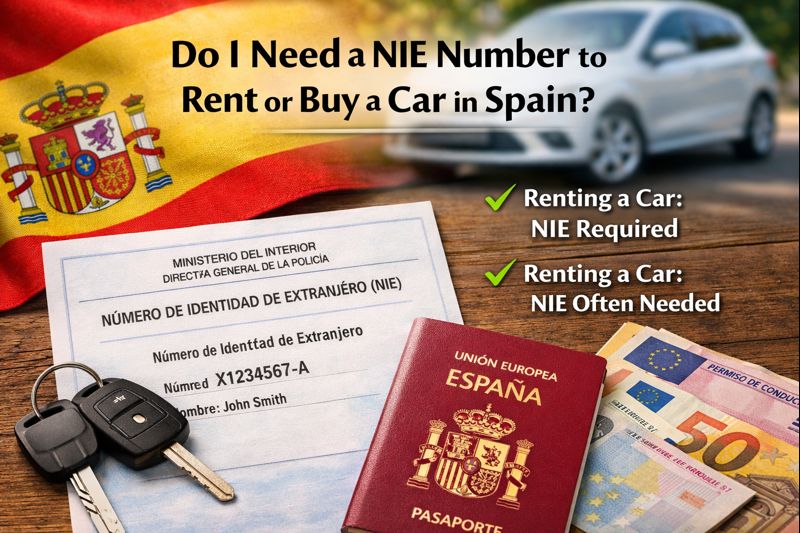
If you are planning to live, work, retire, or even spend extended time in Spain, one of the first practical questions you will face is whether you need a NIE Number to rent or buy a car.
The answer is yes in many situations, but not always—and this is where confusion starts.
Some people successfully rent cars in Spain without a NIE Number, while others are refused. Some buy cars using only a passport, while others are told a NIE is legally required. The rules can feel inconsistent, contradictory, and frustrating—especially for foreigners unfamiliar with Spanish bureaucracy.
This guide explains exactly when a NIE Number is required to rent or buy a car in Spain, when it is not legally mandatory, and why many companies still insist on one anyway. We will also explain how the NIE fits into Spanish law, insurance requirements, vehicle registration, taxes, and long-term residency.
By the end of this article, you will know:
When you do need a NIE Number to rent a car
When you do need a NIE Number to buy a car
When a passport alone may be enough
Why rental companies and dealers often insist on a NIE anyway
What happens if you try to avoid getting one
How to get a NIE Number quickly and legally
What Is a NIE Number in Spain?
A NIE Number (Número de Identidad de Extranjero) is a unique identification number issued by the Spanish authorities to foreign nationals.
It is not a residency permit on its own.
Your NIE Number:
Is issued for life
Never changes
Is used by Spanish authorities to identify you in all legal, financial, and administrative matters
The NIE appears on:
The white NIE certificate (A4 paper)
EU registration certificates (green card)
TIE residency cards
If you interact with the Spanish system—tax, property, vehicles, employment, banking—you will almost certainly need a NIE Number at some point.
Why Does Spain Use NIE Numbers for Cars?
Spain uses the NIE Number for vehicles because:
Cars are registered assets
Vehicles must be insured
Vehicle ownership is linked to tax obligations
Fines, tolls, and penalties must be traceable
From the Spanish government’s perspective, a car is not just transport—it is a legally registered object tied to an identifiable person.
Do You Need a NIE Number to Rent a Car in Spain?
Short Answer
Usually no for short-term rentals, but yes in some situations.
Long Answer
It depends on how long you are renting, who you rent from, and how the car is used.
Renting a Car in Spain Without a NIE Number
Short-Term Tourist Rentals (Most Common)
If you are:
Visiting Spain as a tourist
Renting a car for a few days or weeks
Using a large international rental company
You usually do NOT need a NIE Number.
Most tourist car rental companies only require:
A valid passport
A valid driving licence
A credit card
Minimum age requirements
This is why many tourists believe a NIE is never required for car rentals in Spain.
Why Tourists Can Rent Without a NIE
Tourist rentals:
Are short-term
Do not require Spanish residency
Do not register the car in your name
Do not link you to Spanish tax systems
The rental company remains the legal owner of the vehicle.
When a NIE Number Is Required to Rent a Car
Even for rentals, a NIE Number can be required in the following cases:
1. Long-Term Car Rentals (1–12 Months)
If you rent a car long-term:
Leasing contracts
Monthly rentals
Rent-to-buy agreements
You will almost always be asked for a NIE Number.
Why?
The contract resembles ownership
Insurance is personalised
Spanish address is often required
Tax and liability issues apply
2. Renting as a Spanish Resident
If you:
Live in Spain
Have an address in Spain
Are working or self-employed in Spain
Rental companies may legally require a NIE Number to:
Verify your identity
Register the rental agreement
Comply with Spanish commercial law
3. Renting Commercial or Business Vehicles
If you rent:
Vans
Commercial vehicles
Vehicles for work purposes
A NIE Number is often required, especially if the rental is tied to:
Employment
Autónomo activity
A Spanish company
4. Spanish Insurance Requirements
Some Spanish insurers will not insure a long-term rental driver without a NIE Number.
If insurance cannot be issued, the rental company cannot legally hand over the vehicle.
Do You Need a NIE Number to Buy a Car in Spain?
Short Answer
Yes, in almost all cases.
Long Answer
Buying a car in Spain—new or second-hand—almost always requires a NIE Number.
Why a NIE Is Required to Buy a Car
When you buy a car in Spain, several legal processes take place:
Ownership is transferred
The vehicle is registered with the DGT (Dirección General de Tráfico)
Insurance is issued
Road tax (IVTM) applies
Sales or transfer tax is paid
Every one of these steps requires identification, and for foreigners that identification is the NIE Number.
Buying a New Car in Spain
If you buy a new car from a Spanish dealership, you will need:
NIE Number
Passport
Proof of address
Proof of payment
Spanish insurance
Spanish tax details
The dealer cannot legally register the vehicle without a NIE.
Buying a Second-Hand Car in Spain
For private purchases or used dealerships:
A NIE Number is required for ownership transfer
The DGT will not process the change of ownership without it
Insurance companies will not insure the car in your name
Can You Buy a Car in Spain Without a NIE Number?
Technically, in very rare cases, a car may be purchased without a NIE Number—but this usually causes problems later.
Possible (But Risky) Scenarios:
Car registered in someone else’s name
Car registered under a company
Temporary export registration
Dealer “holding” the car in their name
These options are not recommended and can cause:
Insurance refusal
Fines
Tax issues
Problems selling the car later
Why Some People Think a NIE Is Not Required
Confusion exists because:
Tourists rent cars without NIEs
Some dealers offer “workarounds”
Laws are applied inconsistently
Spain allows flexibility—but not immunity
Legally, ownership and long-term use require identification, and that identification is the NIE.
What About EU Citizens vs Non-EU Citizens?
EU Citizens
Still require a NIE Number
EU citizenship does not replace the NIE
Passport alone is not sufficient for ownership
UK Citizens (Post-Brexit)
NIE Number is required
Additional residency rules may apply
UK driving licences may need exchange
Non-EU Citizens
NIE is mandatory
Often required before insurance can be issued
Driving Licence vs NIE Number: Common Confusion
A driving licence proves you can drive.
A NIE Number proves who you are in the Spanish legal system.
They are not interchangeable.
What Happens If You Try to Buy or Rent Without a NIE?
You may experience:
Delays
Refused insurance
Rejected ownership transfer
Inability to pay road tax
Fines or vehicle immobilisation
Many people only discover they need a NIE after paying a deposit.
Is a NIE Number the Same as Residency?
No.
You can:
Have a NIE without being a resident
Buy or rent a car without living in Spain
Hold a NIE purely for administrative reasons
Do You Need a Spanish Address to Get a NIE?
No.
You can apply for a NIE:
As a non-resident
With a foreign address
For a specific purpose (such as buying a car)
How Long Does It Take to Get a NIE Number?
This depends on:
Location
Appointment availability
Correct paperwork
Processing times can range from:
Same day
A few days
Several weeks (in busy regions)
Why Getting a NIE Early Is Smart
If you plan to:
Stay long-term
Buy a car
Rent long-term
Work
Buy property
Getting a NIE early avoids:
Delays
Lost deposits
Missed opportunities
FAQs – NIE Number and Cars in Spain
Do I need a NIE Number to rent a car as a tourist?
Usually no, for short-term rentals.
Do I need a NIE Number to rent long-term?
Yes, in most cases.
Do I need a NIE Number to buy a car in Spain?
Yes, almost always.
Can I insure a car in Spain without a NIE?
In rare cases, but most insurers require one.
Is a NIE required for second-hand cars?
Yes.
Can I buy a car before I get my NIE?
You can reserve one, but registration requires the NIE.
Is the NIE the same as a TIE?
No. The NIE is the number. The TIE is a residency card.
Do EU citizens need a NIE to buy a car?
Yes.
Do UK citizens need a NIE after Brexit?
Yes.
Is a NIE needed for road tax?
Yes.
Can I use someone else’s NIE?
No. This is illegal.
Is a NIE permanent?
Yes, it is issued for life.
Final Thoughts: Do You Need a NIE Number for a Car in Spain?
Renting a Car
Short-term tourist rental: usually no
Long-term rental or resident use: yes
Buying a Car
New or used: yes
Ownership transfer: yes
Insurance and registration: yes
If a car is part of your life in Spain—not just a holiday extra—a NIE Number is essential.
If you’re moving to Spain, buying property, renting long-term, or even just setting up a more permanent base, one of the first practical questions you’ll ask is:
Do I need a NIE number in Spain to get internet installed?
The short answer is: sometimes yes, sometimes no — and it depends on how, where, and with which company you’re trying to connect.
This guide explains everything you need to know in plain English, including:
When a NIE number is required
When you can get internet without a NIE
The difference between mobile data, fibre, and contracts
Recommended internet providers in Spain
A full FAQ section at the end
What Is a NIE Number (and Why Providers Ask for It)?
A NIE number (Número de Identidad de Extranjero) is Spain’s official identification number for foreigners. It’s used for:
Contracts
Direct debits
Utility accounts
Legal and administrative records
Internet providers often ask for a NIE because:
They run credit checks
They set up long-term contracts
They link your account to a Spanish address
They collect payment via Spanish bank account
But not all internet options in Spain work the same way.
Do You Always Need a NIE Number to Get Internet in Spain?
❌ No — not always
✅ Yes — in many long-term situations
Here’s the reality broken down clearly.
Internet Options in Spain (NIE vs No NIE)
1️⃣ Fibre Internet (Home Broadband)
Usually requires a NIE number
If you want:
Fibre optic internet (FTTH)
A router installed at your property
A 12-month or 24-month contract
Then most major providers will ask for:
NIE number
Passport
Spanish address
Spanish bank account (IBAN)
This is the most common setup for:
Homeowners
Long-term renters
Residents
Digital nomads staying 6+ months
📌 In practice: Without a NIE, your application is often rejected automatically.
2️⃣ Mobile Internet / 4G / 5G Routers
Often possible without a NIE
Many people in Spain start with:
Mobile SIM cards
4G or 5G home routers
Monthly rolling plans
These can often be set up using:
Passport only
Prepaid or no-contract plans
This is popular for:
New arrivals
Property buyers waiting for paperwork
Short-term residents
Holiday homes
⚠️ Speeds are good in cities and coastal areas, but coverage can vary inland.
3️⃣ Prepaid Internet & SIM-Only Plans
No NIE required
Prepaid options usually only require:
Passport
Spanish address (sometimes optional)
Downsides:
Higher cost per GB
No guaranteed speeds
Not ideal for streaming or working from home long-term
Upside:
Instant internet
No paperwork
No contracts
4️⃣ Internet in Someone Else’s Name
No NIE needed (but risky)
Some people:
Use the previous owner’s internet
Put the contract in a Spanish partner’s name
Use a landlord’s existing connection
Be aware:
You are not legally the account holder
Problems can arise with billing or cancellation
Not recommended long-term
Why Internet Providers Ask for a NIE Number
Internet contracts in Spain are treated like utilities. Providers use your NIE to:
Verify identity
Reduce fraud
Link contracts to tax records
Enforce minimum contract periods
Pursue unpaid bills
If you’re asked for a NIE, it’s not personal — it’s procedural.
Best Internet Providers in Spain (2026)
Below are reliable and commonly used providers, especially for foreigners.
🔌 Fibre & Mobile Providers
Movistar Spain’s largest provider. Excellent coverage. Strict paperwork. Usually requires NIE.
Orange Spain Strong fibre network. Competitive bundles. NIE normally required.
Vodafone Spain Good urban coverage. Some flexibility via resellers.
MásMóvil Often cheaper. Still usually requires NIE for contracts.
Digi Spain Very popular with expats. Low prices. Sometimes more flexible.
📡 Mobile & Short-Term Solutions
If you don’t have a NIE yet, these are often the easiest options:
Digi mobile SIMs
Prepaid data plans
4G/5G routers with SIM cards
Rolling monthly contracts
What If You’re Buying Property in Spain?
If you’re buying a property:
You must have a NIE anyway
Most buyers wait until their NIE is issued
Fibre is then straightforward to install
Many buyers temporarily use:
Mobile internet
Prepaid SIMs
Neighbour’s Wi-Fi (with permission)
Can I Apply for Internet While My NIE Is Pending?
Sometimes — but it’s inconsistent.
Some providers may:
Accept proof of NIE application (EX-15)
Allow provisional setup
Still cancel later if NIE isn’t issued
There’s no guarantee, and results vary by region and provider.
Do I Need a Spanish Bank Account as Well?
Often yes.
For fibre contracts:
Spanish IBAN is usually required
Direct debit is standard
Some mobile providers allow:
Card payments
Foreign IBANs
Monthly top-ups
When It Makes Sense to Get a NIE First
Getting a NIE early makes life easier if you want:
Home internet
Utilities in your own name
Phone contracts
Electricity, water, gas
Long-term stability
It removes 90% of the friction.
FAQs – NIE Numbers and Internet in Spain
❓ Can I get internet in Spain without being a resident?
Yes. Residency is not required. A NIE is often enough.
❓ Can tourists get internet in Spain?
Yes. Tourists can use prepaid SIM cards and mobile data without a NIE.
❓ Is fibre internet faster than mobile internet?
Yes. Fibre is more stable, faster, and better for working from home.
❓ Can I use my UK or EU passport instead of a NIE?
Only for prepaid or short-term options. Contracts usually require a NIE.
❓ How long does it take to install fibre internet in Spain?
Typically 3–10 working days once paperwork is approved.
❓ Can I cancel if I leave Spain?
Most fibre contracts have minimum terms (12 months). Early cancellation fees may apply.
❓ Is Wi-Fi included with internet installation?
Yes. Providers supply a router, usually included or rented monthly.
Final Verdict: Do You Need a NIE Number to Get Internet in Spain?
✔ Yes, if you want:
Fibre internet
A long-term contract
Utilities in your own name
❌ No, if you’re happy with:
Mobile internet
Prepaid SIMs
Temporary solutions
If Spain is more than a short stay, getting your NIE early saves time, money, and stress — especially when setting up essentials like internet.
(The Honest Answer Landlords Don’t Always Explain)
Picture this.
You’ve found the apartment. White walls, a sunny balcony, maybe a suspiciously cheap rent “because the owner just wants a nice tenant”. You message. They reply instantly. Then—out of nowhere—they ask:
“Can you send your NIE number?”
Cue mild panic.
Do you actually need a NIE to rent in Spain… or is this one of those “Spain things” that everyone argues about in Facebook groups?
Let’s clear it up properly — no myths, no guesswork, no legal waffle, and with real-world examples that reflect how renting actually works in Spain today.
The Short Answer (But Don’t Stop Reading)
No — you do NOT legally need a NIE number to rent a property in Spain.
But… (and this is a big “but”)
👉 In practice, many landlords, agencies, and utility companies will strongly prefer it — or quietly insist on it.
This article explains:
What the law says
What landlords actually do
When you can rent without a NIE
When you’ll hit a wall
And how to avoid losing a great rental over paperwork
What Is a NIE Number (Quick Refresher)
A NIE (Número de Identidad de Extranjero) is your official foreigners’ identification number in Spain.
It’s used to track:
Taxes
Contracts
Property
Bank accounts
Utilities
Legal and administrative activity
Think of it as Spain’s master reference number for foreigners — not a residence permit, not a visa, just an ID number.
What Spanish Law Actually Says About Renting Without a NIE
Here’s the important bit:
📌 Spanish law does NOT require a tenant to have a NIE in order to sign a rental contract.
A valid contract can be signed using:
A passport
A foreign ID card
Full personal details
A legal address for notifications
From a purely legal standpoint, a rental contract signed with a passport is valid and enforceable.
So why does the confusion exist?
Because Law ≠ Real Life in Spain
Welcome to Spain, where:
What’s legal
What’s normal
And what’s easy
…are three very different things 😅
While you can rent without a NIE, many landlords and agents prefer tenants with one because it makes their life easier.
Let’s break down why.
Why Landlords Prefer Tenants With a NIE
1. Taxes & Declarations
Landlords must declare rental income. A tenant with a NIE:
Fits neatly into Spanish tax systems
Reduces questions from Hacienda
Looks “official” on paperwork
2. Long-Term Stability
A tenant with a NIE is often seen as:
Staying longer
More invested in Spain
Less likely to disappear overnight
Fair? Not always. Common? Very.
3. Utility Contracts (The Big One)
Even if the rental contract is fine…
👉 Electricity, water, gas, and internet providers often require a NIE.
If utilities need to be:
Transferred into your name
Newly connected
Recontracted
…then a NIE suddenly becomes very important.
When You CAN Rent in Spain Without a NIE
Let’s get practical.
You can usually rent without a NIE if:
✅ The rental is short-term ✅ Utilities stay in the landlord’s name ✅ You pay a few months upfront ✅ You’re dealing directly with the owner ✅ The contract is under 11 months
This is very common with:
Holiday lets
Winter rentals
Trial stays
Digital nomads testing the waters
When You’ll Likely Be Asked for a NIE
You’ll almost certainly need (or be pushed to get) a NIE if:
❌ The contract is long-term (12 months+) ❌ The landlord uses a formal agency ❌ You need utilities in your name ❌ You’re registering at the padrón ❌ You want Spanish banking, insurance, or residency
In these cases, not having a NIE won’t always block you — but it will slow everything down.
The “Passport Is Fine… Until It Isn’t” Problem
Many renters start with:
“Don’t worry, passport is fine!”
Then later hear:
“The electricity company won’t accept it”
“The bank needs a NIE”
“We can’t register you at the town hall”
“We need it for the deposit certificate”
Suddenly, your rental is secure — but your life admin is stuck.
This is why many people choose to sort the NIE before or immediately after renting.
Do Letting Agents Require a NIE?
Officially? No. In practice? Often yes.
Agencies prefer NIE holders because:
Contracts are standardised
Deposits are registered properly
Tenant details are clean for audits
Some agencies won’t even show properties without one — especially in competitive areas.
What About Illegal or “Cash” Rentals?
Yes, they exist. Yes, people do it. No, it’s not smart long-term.
If a landlord:
Avoids contracts
Refuses to register anything
Doesn’t want IDs
That’s a red flag 🚩
A proper rental — even short-term — protects you.
Can I Get a NIE Just to Rent?
Absolutely. You do not need residency to apply for a NIE.
Common acceptable reasons include:
Renting a property
Preparing to move to Spain
Future employment
Banking or legal needs
In fact, renting is one of the most common reasons people apply for a NIE.
The Timing Mistake Many Renters Make
Many people wait until:
They’ve found a property
The landlord asks for a NIE
The agency puts pressure on
Then discover:
Appointments are weeks away
Local police slots are full
Paperwork is confusing
Meanwhile… the property goes to someone else.
Why Getting a NIE Early Makes Renting Easier
Having a NIE:
Makes you more attractive as a tenant
Speeds up contracts
Avoids utility delays
Helps with banking & padrón
Removes last-minute stress
Even if it’s not legally required, it’s strategically useful.
Common NIE & Renting Myths (Busted)
❌ “You can’t rent without a NIE” False.
❌ “Only residents can get a NIE” False.
❌ “A NIE means tax residency” False.
❌ “Tourists can’t apply” False.
❌ “You must rent first to apply” Also false.
Renting in Spain: The Smart Order
If you want the smoothest experience:
1️⃣ Apply for your NIE 2️⃣ View and secure a rental 3️⃣ Sign the contract 4️⃣ Set up utilities 5️⃣ Register locally (if needed)
This order avoids 90% of the common problems.
Final Verdict: Do You Need a NIE to Rent in Spain?
Legally? No. Practically? Often yes. Smart move? Definitely.
You can rent without one — especially short-term — but if you’re planning any kind of settled life in Spain, a NIE quickly becomes essential.
FAQs – Renting in Spain & NIE Numbers
Can I sign a rental contract with just a passport?
Yes. A passport is legally valid for signing a rental contract.
Will a landlord refuse me without a NIE?
Some will, especially agencies and long-term landlords.
Can utilities stay in the landlord’s name?
Yes, but many landlords prefer transfers for long-term rentals.
If you are thinking about buying a house in Spain — whether it’s a holiday home, an investment property, or a place to live full-time — one of the first questions you will encounter is:
Do I need a NIE Number to buy property in Spain?
The short answer is yes — in almost all cases, you cannot legally buy a property in Spain without a NIE Number.
But the why, the when, and the how are just as important as the answer itself. This guide explains everything you need to know, step by step, including what happens if you don’t have a NIE yet, how long it takes to get one, and how to avoid common mistakes that delay property purchases.
What Is a NIE Number?
A NIE Number (Número de Identidad de Extranjero) is a tax identification number for non-Spanish nationals.
It is issued by the Spanish authorities and is used to identify you in all financial, legal, and administrative transactions in Spain.
Once issued, your NIE number is unique and permanent — it never changes and stays with you for life.
Why Spain Requires a NIE Number for Property Purchases
Spain’s legal and tax system is built around personal identification numbers. Spanish citizens use a DNI, and foreigners use a NIE.
When you buy a property, the Spanish authorities must be able to:
Identify who you are
Register ownership in your name
Link you to tax obligations
Record the transaction in the Land Registry
Report the purchase to the tax office
Without a NIE number, none of this can happen.
Is a NIE Number Legally Required to Buy a House in Spain?
Yes. A NIE number is legally required to:
Sign the title deeds (Escritura Pública)
Register the property in the Land Registry
Pay property purchase taxes
Set up utilities in your name
Pay ongoing property taxes
Open a Spanish bank account (almost always required)
In practice, no notary will complete a property purchase without a NIE.
At What Stage Do I Need a NIE Number?
This is where many buyers get caught out.
You need a NIE before completion, not just before viewing
You can:
View properties
Make offers
Reserve a property
without a NIE number.
But you cannot:
Complete the purchase
Sign the deeds
Transfer ownership
without one.
Ideal timing
To avoid delays, you should apply for your NIE as soon as you decide to buy — ideally before paying a deposit.
Can I Buy a House in Spain as a Non-Resident?
Yes. Spain places no restriction on foreign property ownership.
You can buy property in Spain if you are:
A non-resident
A UK passport holder post-Brexit
An EU citizen
A non-EU citizen
However, every foreign buyer still needs a NIE number, regardless of residency status.
Does Brexit Change the NIE Requirement?
No.
Brexit changed residency rules, not property ownership rules.
UK citizens:
Still need a NIE number
Can still buy property freely
Do not need residency to purchase
The NIE remains mandatory for all UK buyers, whether resident or non-resident.
Do I Need a NIE If I’m Buying With Someone Else?
Yes — each buyer needs their own NIE number.
Examples:
Married couple → two NIEs required
Joint investment partners → each partner needs a NIE
Buying in joint names → every named owner must have a NIE
A property cannot be registered in the name of someone without one.
What If I’m Buying Through a Company?
If you are buying through:
A Spanish company
A foreign company
Different identification numbers apply (such as a CIF), but directors and legal representatives often still need a NIE.
This should always be confirmed with a lawyer before proceeding.
Can a Lawyer Buy the Property for Me Without a NIE?
No.
Even if you give power of attorney, the property is still being registered in your name — and that name must be linked to a NIE.
A lawyer can:
Apply for the NIE on your behalf
Sign documents for you
But they cannot bypass the NIE requirement.
What Happens If I Don’t Have a NIE in Time?
This is one of the most common (and costly) problems buyers face.
Without a NIE:
Completion is delayed
Notary appointments are cancelled
Sellers may refuse extensions
Deposits can be put at risk
In competitive markets, delays can result in losing the property entirely.
How Long Does It Take to Get a NIE Number?
Timeframes vary depending on:
Location
Police availability
Whether you apply in Spain or abroad
Typical timelines:
In Spain (DIY): 2–8+ weeks
Through a professional service: often much faster
Because property purchases are time-sensitive, speed matters.
Why Many Buyers Use a NIE Specialist
While you can apply yourself, many buyers choose a specialist because:
Appointments are difficult to secure
Forms must be completed correctly
Errors cause rejection or delays
Property timelines are unforgiving
A delayed NIE can derail an entire purchase.
Is the NIE Number Only Needed for the Purchase?
No. Your NIE is used long after you buy the property, including for:
Paying annual property taxes
Utility bills
Selling the property later
Inheritance matters
Declaring rental income
Once issued, it remains valid for life.
Do I Need a NIE to Open a Spanish Bank Account?
In almost all cases, yes.
Most Spanish banks require:
NIE number
Passport
Proof of address
Since property purchases typically require a Spanish bank account, the NIE becomes unavoidable.
Can I Apply for a NIE From Outside Spain?
Yes.
You can apply:
Via a Spanish consulate abroad
Through a representative in Spain
However, consulate applications are often slow, which is why buyers on tight timelines usually avoid this route.
If you’ve spent more than five minutes researching life in Spain, you’ve probably heard this phrase shouted across forums, Facebook groups, WhatsApp chats, and pub conversations in coastal towns:
“You can’t do anything in Spain without a NIE.”
Sounds terrifying, right?
Now here’s the truth — and it might surprise you:
👉 Yes, you can open a bank account in Spain without a NIE number. 👉 But not all bank accounts. 👉 And not in all situations. 👉 And not without a few catches.
This article explains exactly how it works, when it’s possible, when it’s not, which banks allow it, what type of account you’ll get, what it costs, and — most importantly — when getting a NIE first actually saves you time, money, and stress.
No myths. No fluff. No outdated advice from 2014.
Let’s get into it 🇪🇸💳
The Short Answer (Before the Real Explanation)
Yes, you can open a Spanish bank account without a NIE, but only as a non-resident, and it usually comes with:
Higher monthly fees
More paperwork
Fewer features
Extra scrutiny
And eventual pressure to get a NIE anyway
So while it is possible, it’s often not the best long-term solution.
Now let’s break down why.
What Is a NIE — and Why Banks Care So Much
A NIE (Número de Identidad de Extranjero) is Spain’s official identification number for foreigners.
Banks care about it because it allows them to:
Verify your identity with Spanish authorities
Link you to tax and compliance systems
Satisfy anti-money-laundering regulations
Confirm residency status
Report interest to the Spanish tax office (when required)
Without a NIE, banks treat you as temporary, external, and higher risk.
That doesn’t mean no account — it just means a different type of account.
The Two Types of Spanish Bank Accounts (This Is Crucial)
1️⃣ Non-Resident Bank Accounts (No NIE Required)
This is the account most people get before their NIE.
Key features:
Designed for tourists, second-home owners, and short-term visitors
Requires a passport instead of a NIE
Subject to stricter checks
Higher monthly fees
Often limited functionality
These accounts exist specifically for people without a NIE.
2️⃣ Resident Bank Accounts (NIE Required)
This is the normal, everyday Spanish bank account.
Key features:
Requires a NIE
Much lower (or zero) monthly fees
Easier online banking
Direct debits, salary payments, utilities
Accepted everywhere without issues
Most people eventually need this account.
So Yes — You Can Open a Bank Account Without a NIE (Here’s How)
To open a non-resident Spanish bank account, you’ll usually need:
Valid passport
Proof of address outside Spain
Proof of income or funds (sometimes)
Non-resident declaration form
In-person visit to a branch
Patience 😄
Some banks may also ask for:
Spanish phone number
Explanation of why you need the account
Source of funds declaration
Which Spanish Banks Allow Accounts Without a NIE?
Most major banks technically allow it, but the experience varies wildly by branch and staff member.
Common banks offering non-resident accounts include:
Banco Santander
BBVA
CaixaBank
Sabadell
Important reality check:
👉 There is no “national rule” applied consistently. 👉 Branch discretion matters more than bank branding.
One branch may say “Impossible without a NIE”, while another does it in 20 minutes.
Welcome to Spain 🇪🇸
The Hidden Cost of Non-Resident Accounts
Here’s where most people get caught out.
Typical Non-Resident Account Fees
Monthly fee: €15–€30
Annual cost: €180–€360
International transfer fees
Card fees sometimes charged separately
Some banks also charge a non-resident verification fee every two years.
Compare that with many resident accounts:
€0 monthly fees
Free debit cards
Free SEPA transfers
Suddenly, getting a NIE doesn’t feel optional anymore…
Can Tourists Open a Spanish Bank Account Without a NIE?
Yes — tourists absolutely can.
But it’s usually only worth doing if:
You’re buying a property
You need to pay Spanish taxes
You’re staying long-term seasonally
You need a Spanish IBAN urgently
For short holidays? 👉 It’s usually unnecessary.
Can I Open a Spanish Bank Account Online Without a NIE?
This is where misinformation explodes online.
The truth:
❌ Most Spanish banks do not allow full account opening online without a NIE ❌ Apps often stop halfway and request NIE details ❌ Video ID checks still lead to branch visits
Some fintechs offer IBANs, but:
They’re not always accepted for utilities
Some Spanish authorities reject them
They don’t replace a traditional bank account
Will the Bank Eventually Ask Me for a NIE?
Almost always.
Common scenarios:
Account review after 6–12 months
Compliance audit
Large transfers
Property purchase
Utility payments setup
Banks may say:
“Please provide your NIE or we may restrict the account.”
This is normal, not personal.
Do I Need a NIE to Buy Property If I Already Have a Bank Account?
Yes. 100%. No exceptions.
Even if you opened a non-resident bank account:
Notary requires NIE
Property registry requires NIE
Taxes require NIE
A bank account does not replace a NIE.
Can I Pay Bills Without a NIE?
Technically yes — but practically messy.
Some companies:
Refuse non-resident IBANs
Reject certain account types
Flag accounts for compliance
Many utilities expect a resident account.
The Smart Route Most People Take (And Why)
Here’s what actually works best for most foreigners:
1️⃣ Open a non-resident account temporarily (if needed urgently) 2️⃣ Apply for a NIE as soon as possible 3️⃣ Convert or reopen as a resident account 4️⃣ Reduce fees and unlock full features
This avoids:
Paying €300+ per year unnecessarily
Bank freezes
Rejected payments
Stressful compliance emails
Why Banks Often Give Conflicting Answers
Three reasons:
Staff training varies
Internal policy changes frequently
Risk tolerance differs by branch
So when someone online says “I was told no” — it doesn’t mean you will be.
Is It Easier to Get a NIE First, Then Open a Bank Account?
In most cases?
👉 Yes. Massively easier.
With a NIE:
Faster account opening
Fewer questions
Lower fees
More banking options
This is why many people now sort the NIE first, then handle banking smoothly.
Common Myths (Let’s Kill These Once and For All)
❌ “You can’t open any bank account without a NIE” ✔️ False
❌ “Tourists are not allowed bank accounts” ✔️ False
❌ “Online banks avoid NIE rules” ✔️ Mostly false
❌ “Once opened, you’ll never need a NIE” ✔️ Very false
FAQs: Opening a Bank Account in Spain Without a NIE
Can I open a Spanish bank account with just a passport?
Yes — as a non-resident, depending on the bank and branch.
Is a NIE mandatory for all Spanish bank accounts?
No — only for resident accounts.
Are non-resident accounts safe?
Yes, but they’re more expensive and limited.
Can I receive money from abroad without a NIE?
Yes, but large transfers may trigger checks.
Can I later add my NIE to the same account?
Often yes — but sometimes banks require a new account.
Is a Spanish bank account required to apply for a NIE?
No — the NIE comes first, independently.
Will my account be closed if I don’t get a NIE?
It can be restricted or flagged over time.
Do UK citizens need a NIE to open a bank account after Brexit?
Same rules as other non-EU nationals — non-resident account first, NIE later.
Final Verdict: Should You Open a Bank Account Without a NIE?
Yes, you can. But no, it’s not ideal long-term.
If you need:
A temporary solution → Non-resident account works
Full Spanish life setup → Get your NIE first
The Spanish system is built around the NIE. Banking is no exception.
Here are suggested banks where you can open a bank account in Spain without a NIE number (as a non-resident), including links to their official sites and a quick note on the situation 👇
Non-Resident Account: BBVA allows non-residents to open accounts using a valid passport in many branches. You’ll need to visit one of their offices to complete the process. 🔗 https://www.bbva.es
🏦 3. Banco Sabadell
Non-Resident Account:Key Account is available for non-residents, and you can open it with just a passport and identity documents. It often includes a free debit card and basic banking features. 🔗 https://www.bancsabadell.com/bsnacional/en
🏦 4. CaixaBank
Non-Resident Account: Although traditionally they ask for NIE for resident accounts, CaixaBank also supports non-resident accounts for foreigners; they have options tailored to people without a NIE. Check their Cuenta para Extranjeros for details and eligibility. 🔗 https://www.caixabank.es/particular/cuentas
💳 5. Digital & Neobank Alternatives (often easier without NIE)
These aren’t traditional Spanish banks, but they let you get a European (often Spanish IBAN) account with just a passport — perfect if you don’t have a NIE and want an online solution:
N26 – mobile-first European bank with easy online signup. 🔗 https://n26.com
📌 Notes & Tips
Non-Resident vs Resident: All of the above allow non-residents to open accounts without a NIE, but only non-resident accounts — you still might need a NIE later for resident accounts or advanced services.
In person vs online: Some banks require you to visit a branch to open the account in person, while others offer digital onboarding if you live abroad.
Documentation: You’ll usually need your passport, proof of address in your home country, and sometimes a non-resident certificate — but not a NIE upfront.
If you’ve landed in the Jalon Valley (Valle de Jalón / Vall de Pop) and you’re thinking, “Right… I need a NIE,” you’re in excellent company. Somewhere between the first café con leche in Xaló (Xalón) and your third walk past orange groves that smell like actual happiness, it hits you: Spain runs on paperwork. Glorious, stamp-powered, appointment-dependent paperwork.
The good news? Getting a NIE number is absolutely doable. The even better news? Doing it from the Jalon Valley can be surprisingly pleasant if you approach it like a local: start early, keep a folder, and never underestimate the power of a polite “Buenos días.”
A NIE (Número de Identidad de Extranjero) is your foreigner identification number in Spain. It’s not a residency card, not a visa, and not a “membership number” for a beach club in Moraira (sadly). It’s a tax/administrative IDSpain uses to identify you in official processes.
Think of it like Spain’s way of saying: “Hello, you. We’re going to need to reference you… in triplicate.”
Your NIE number is used for loads of real-life stuff, like:
Buying property (your future casita with a lemon tree)
Paying taxes connected to property or inheritance
Setting up certain contracts or official registrations
Buying a car or registering a vehicle
Opening many bank accounts (some banks are more flexible than others)
Starting self-employment (autónomo)
Some longer-term rentals and utilities situations (varies by company)
In the Jalon Valley, it often starts with a simple goal like: “We want to buy a house near Alcalalí / Parcent / Llíber.” Then quickly escalates into: “We need a NIE, a bank account, a notary date, and why is everyone talking about Modelo 790 like it’s a cousin?”
The Jalon Valley Factor: Why This Area Changes the NIE Experience
The Jalon Valley has a particular rhythm. It’s not a frantic city sprint. It’s more like:
Markets on Saturday (Xaló’s rastro energy is unmatched)
Bargain hunting, followed by
A long lunch, followed by
“We’ll do the paperwork on Monday.”
That’s great for your soul, but Spanish admin works best when you’re slightly more organised than you feel.
People living around Xaló, Llíber, Alcalalí, Parcent, Murla, Benigembla and the surrounding villages often have to travel to a larger town/city for the actual NIE process. That means planning transport, timing, and making sure you don’t arrive with 97% of the paperwork and discover you’re missing the one tiny thing they care about most that day.
The Jalon Valley also has a big international community, so it’s normal to hear conversations like:
“I got my NIE in Dénia.”
“No, you need the Policía Nacional office.”
“Try early morning for appointments.”
“My friend’s cousin’s neighbour refreshed the website for three days and then got one.”
This guide will make that whole situation less chaotic.
NIE vs Residency: A Quick Clarity Moment
A common mix-up (especially for people moving to the Costa Blanca) is thinking:
“If I get a NIE, I’m officially resident.”
Not necessarily.
NIE number = identification number for foreigners (often the first step)
Residency/TIE = separate process (especially relevant for non-EU citizens and post-Brexit UK nationals)
Many people in the Jalon Valley get a NIE simply for property purchase or official transactions, without immediately applying for longer-term residency. Others do both. Different pathways, different outcomes.
The Three Most Common Reasons People in the Jalon Valley Need a NIE
1) Buying a home (or land, or a renovation project)
The Vall de Pop is full of dream properties: terraces, views, almond blossom, and “just needs a bit of work” houses that become a full-time hobby.
To buy property in Spain, you’ll usually need a NIE number for:
the purchase itself
notary paperwork
setting up utilities/taxes afterward
2) Handling inheritance or legal matters
Sadly common, but important. If you inherit property or need to deal with legal affairs in Spain, you often need a NIE.
3) Long-term admin life
Cars, taxes, certain bank procedures, self-employment, official registrations—Spain loves a number.
The Core Routes to Get a NIE (Explained Simply)
In practice, most people get a NIE by applying in Spain through:
Policía Nacional (commonly used route)
Oficina de Extranjería (immigration office route)
The exact location and which office you use can depend on where you’re registered, demand, and appointment availability. People living around Jalon Valley often look at options in nearby bigger hubs.
If you’re applying from outside Spain, you can also apply through a Spanish consulate in your home country. Some people do this to avoid the appointment scramble in Spain, but timelines and requirements vary by consulate.
The Paperwork You’ll Hear About (Without the Boring Lecture)
Here are the forms that come up most often for a straightforward NIE assignment:
✅ Modelo EX-15
This is the standard application form for NIE assignment (often used when you need the number for economic/administrative reasons, like property purchase).
✅ Modelo 790 (fee form)
You pay a small government fee for the NIE process. The form is commonly referred to by the “Modelo 790” name and includes a specific code variant depending on the procedure.
✅ Your passport + copies
Spain doesn’t just want to see your passport. It wants to see it… and also see copies of it.
✅ Reason / justification
This is where people stumble. You typically need to explain why you need the NIE, and sometimes show supporting documentation—e.g. a property reservation contract, notary communication, or paperwork that demonstrates an administrative need.
Local reality check: If you’re buying in Xaló/Parcent/Llíber, your estate agent or solicitor may give you a document that helps justify the request. Keep it printed.
The Appointment System: The Part Everyone Loves to Hate
To apply in Spain, you usually need a cita previa (prior appointment). This is where many otherwise confident adults turn into people whispering:
“I refreshed the website at 7:58am and got nothing.”
A few grounded truths:
Appointments can appear in batches.
Availability can vary by office.
It can feel random, but there is usually a pattern if you’re consistent.
Having everything ready before you find an appointment is the secret.
Jalon Valley strategy: Because you’re not in a major city, you benefit from being flexible about where you go (within reasonable travel distance). People often combine an appointment trip with errands: a big shop, a coffee stop, maybe even a seaside walk afterwards so it doesn’t feel like you’ve devoted your whole life to a stamp.
Step-by-Step: How to Get Your NIE While Living in the Jalon Valley
Step 1: Decide what you’re applying for (and why)
Write your reason in one clean sentence:
“I need a NIE to purchase a property in Xaló (Alicante).”
“I need a NIE for property-related administrative and tax purposes.”
“I need a NIE to complete a legal or financial transaction in Spain.”
Keep it simple. Spain appreciates a clear purpose.
Step 2: Prepare your paperwork folder (the “Spain Admin Survival Kit”)
Create a folder (physical) and a folder (digital).
Include:
Passport (original)
Copies of passport ID page (and any relevant pages if requested)
Local tip: The Jalon Valley is relaxed, but your appointment office will not be. If you arrive with loose papers in a tote bag that also contains a baguette and a market vase, you’re playing paperwork roulette.
Step 3: Pay the fee properly (and keep proof)
The fee is typically paid via bank using the relevant form. Make sure you keep the stamped/confirmed proof of payment.
Reality in this area: Some people do this while they’re already in a bigger town for other errands, rather than trying to do everything last minute.
Step 4: Attend your appointment like a calm, organised adult
On the day:
Arrive early
Bring originals and copies
Be polite and clear
Don’t overshare your life story (keep the explanation short)
Have your contact details to hand
If something is missing, you may be told to return or rebook. This is why the folder matters.
Step 5: Receive your NIE
Depending on the office and process, you may:
receive it same day, or
be told when/how to collect it, or
get instructions for later retrieval
This part varies. The key is: once you have the number, treat it like gold. Save scans, store it securely, and keep multiple copies. You will use it more than you expect.
Local References: Making the NIE Process Fit Jalon Valley Life
Let’s make this real.
You’re in the Vall de Pop. Your week looks like:
Monday: “We’ll go get the NIE stuff done.”
Tuesday: “We ended up in Alcalalí for coffee.”
Wednesday: “We discovered a new walk near Parcent.”
Thursday: “We found a house that’s perfect but the terrace is 30cm too narrow.”
Saturday: “Xaló market again, obviously.”
So here’s how to integrate the NIE mission without it taking over your identity:
Make one “paperwork morning” a week
Pick one morning (locals love mornings for admin). Keep it consistent. Use that morning to:
print documents
check appointment availability
organise copies
prepare fees
Use the “bigger town combo trip”
When you have to travel for an appointment, build in something nice:
coffee stop
seaside walk
a proper lunch afterwards It changes your mindset from “admin nightmare” to “productive day out.”
Learn the three Spanish phrases that make you look like you know what you’re doing
“Tengo cita previa.” (I have an appointment.)
“Vengo a solicitar el NIE.” (I’m here to apply for the NIE.)
“Aquí están las copias.” (Here are the copies.)
Even if you say nothing else, those help.
Common Mistakes (So You Can Avoid the “Second Trip”)
Mistake 1: Not bringing copies
The biggest classic. Spain loves copies the way the Jalon Valley loves a long lunch.
Mistake 2: Turning up with an unclear reason
“I might buy a house one day” is not as strong as “I’m in the process of purchasing property and require a NIE for tax/notary purposes.”
Mistake 3: Paying the wrong fee or missing proof of payment
Always keep the payment proof with your appointment paperwork.
Mistake 4: Assuming a NIE = residency
It’s not the same thing. If you need residency documentation, that’s a separate process.
Mistake 5: Waiting until the last minute (especially for property purchases)
If you’ve found your dream place near Llíber and your notary date is looming, the appointment scramble becomes ten times more stressful. Start early.
How Long Does It Take?
This depends mostly on:
how quickly you can get an appointment
the office demand
whether your paperwork is correct first time
Some people get through quickly. Others take longer because appointment availability is the bottleneck.
The best “speed hack” is not a hack at all: Have everything ready before you start chasing appointments.
Special Note for UK Passport Holders (Post-Brexit Reality)
If you’re a UK national living in or moving to the Jalon Valley, your NIE may be part of a wider admin journey.
You might need:
NIE (number)
residency process (depending on your plans/status)
TIE card (in many cases)
padrón registration at the town hall (often recommended/required for various processes)
Different people have different situations. The key is not to assume “NIE done = everything done.”
A Fun Way to Think About It: The Jalon Valley NIE Quest
Imagine your NIE mission as a Vall de Pop quest with five levels:
The Folder of Destiny (collect documents)
The Copy Shop Challenge (print everything twice)
The Appointment Labyrinth (cita previa)
The Stamp of Approval (the office visit)
The Number That Unlocks Doors (you now have a NIE)
Once you’ve done it, you’ll spot other newcomers and instantly recognise the look in their eyes when they say: “We’re trying to get an appointment…”
That’s when you nod slowly, like a local elder, and say: “Have you got your copies?”
Getting a NIE in Jalon Valley
If you’re searching for how to get a Spanish NIE number in Jalon Valley, the process is straightforward once you understand the steps:
Prepare EX-15, passport, copies, fee payment proof, and a clear justification
Secure a cita previa at the appropriate office
Attend the appointment with organised paperwork
Receive your NIE number and keep it safely for property, banking, legal and tax needs
Whether you’re buying a home near Xaló, Llíber, Alcalalí, Parcent, Murla or just setting up your official life in Alicante province, the NIE is one of the first keys you’ll need.
Final Local Pep Talk
The Jalon Valley teaches you something quietly powerful: life doesn’t need to be rushed. But Spanish admin teaches you something equally powerful: some things do need to be prepared.
So do it the Jalon way:
plan it calmly
keep your folder tidy
get it done early
celebrate afterwards (preferably somewhere with sunshine and a good menú del día)
And once your NIE number is in hand, you’ll feel it: that satisfying moment of being slightly more “official” in Spain—without losing the relaxed rhythm that brought you to the Vall de Pop in the first place.
Getting your NIE Number in Arcos de la Frontera, Andalucia is easy using our service. Visit our home page to read more and use our easy booking for to apply within 24hrs. Click the home button above to read more about MY NIE website.
You don’t need your Spanish NIE Number to visit Arcos de la Frontera
Here at MY NIE we like to go traveling around and meet some of our valued customer. This week we went to visit mother and son team Jakie and Stewart to find out how using our service they managed to get there NIE Number and open a bar in Arcos de la Frontera, Andalucia.
White villages (known as the pueblos blancos in spain) in Andalucía are common place but the Arcos de la Frontera, Declared a national historic-artistic monument in 1962 is perched high on a hill side really does set the Spanish seen beautifully.
Boasting whitewashed town houses and huge stone walls backing up to a sheer cliff face the town looks down to the river Guadalete below.
The impressive looking old town with cobbled streets and quirky houses and cafes lead you up to the castle (Castillo de los Arcos) where you can find an impressive view over the hills and mountains.
The town is no buzzing tourist or industrial hub there days but during its time under the Moors it was one of its most successful towns in the area.
We asked Jackie and Stewart there thoughts on our service
Q: So guys, you used our service to get your Spanish NIE Numbers in Arcos de la Frontera. How did you find the service? Did you Find the NIE Number booking website easy to use?
A: We loved your service! It was so quick and simple. We needed our Spanish NIE Numbers urgently as we had jobs lined up but couldn’t start until we had our paper NIE Certificate. We got a phone call within 20 minutes of placing the order which we was surprised and by the next day we was booked in at the Police Station. We had our Spanish NIE Numbers in 4 weeks from the date we placed our orders.
Q: Would you recommend our NIE Number service to other people?
A: Yes, we certainly would. There’s so many Company’s on the web offering the service to get your Spanish NIE Number, but your website was the cheapest and fastest and we found it really easy to use.
Q: How do you find working in Spain now you have your NIE Number?
A: Now we have our Spanish NIE Number paper certificate its much easier for us to get jobs. Unfortunately the bar Stewart was working in closed down so he needed to get another job, and fast. As he already had his NIE Number this made the whole process much easier.
Q: Do you think a lot of Ex-pats moving to Spain Fully understand the process and why they need a NIE Number?
A: Jackie replied: No, we think a lot of people are confused about how to get a NIE Number in Spain. That’s why we liked your website www.mynie.co.uk so much as it made the process so quick and simple.
Q: How was your experience at the Police Station when you went to get your NIE Number?
A: We was a little nervous at first to be honest. The police station was busy. Thank you for the map you sent us it made getting to the Police station much easier, we would never have found it otherwise. Once we was called up we gave in our paperwork and showed our passports. We was told to come back in the afternoon and our Spanish NIE Number was printed off waiting for us to collect. We was very happy.
Q: Did any of the NIE Number process surprise you?
A: We was surprised how quick we got a phone call from MY NIE. it was really quick within 20 minutes. So many people had mentioned that the NIE Number is a green card so we was surprised it was printed on A4 paper. We looked back at the website and did notice you say it is not a card.
Q: Now you have your NIE Number where do you keep it?
A: Now we have our numbers we keep a photo copy on us all the time and we also have a photo of the certificate on our phones. Our original NIE Number certificates are kept in the safe in case we need them for official use one day.
We had a lovely afternoon with Jackie and Stewart talking about there NIE Number experience in Arcos de la Frontera . We wish them every luck with there new life in Spain.
If you’re planning to buy a property, rent long-term, work, start a business, open a bank account, register a car, or sort out residency in Spain, you’ll quickly run into one essential requirement: a NIE number.
Your NIE (Número de Identidad de Extranjero) is your foreigner identification number. It’s not “residency” by itself, and it’s not the same as a TIE card or padrón registration—but it is the reference number Spanish authorities and many private institutions use to identify you for paperwork and transactions.
If you’re based in Denia(or the Marina Alta area), getting a NIE can be straightforward—but only if you understand the system, prepare correctly, and secure the right appointment type. This guide explains how to get a NIE number in Denia, what you need, what to expect, common mistakes, and how www.mynie.co.uk can support you from start to finish.
A NIE number is an identification number assigned to foreigners in Spain. It begins with a letter (X, Y, or Z), followed by numbers and a final letter. You’ll use it on:
In the Denia/Marina Alta zone, many applicants are routed via Alicante province appointment systems and may end up attending an office that covers the area (sometimes not in Denia itself depending on availability and the type of appointment). The practical reality is:
The correct appointment category matters more than the exact building you want.
Availability can fluctuate, and you may need flexibility on location and timing.
This is where support services help most: knowing which appointment type to book, where it’s likely to be available, and ensuring your paperwork is accepted the first time.
Patience and flexibility (sometimes across nearby offices)
Step 7: Attend the appointment with all paperwork
On the day, bring:
EX-15 completed and signed
Passport original + copies
Justification documents
Modelo 790 fee proof
Any extra supporting documents (always wise)
A pen (seriously—offices sometimes don’t have spares)
At the appointment, the officer checks your documents, may ask questions about your reason, and processes the request.
Find the NIE Number office in Denia on Google Maps
Step 8: Receive your NIE certificate / confirmation
Depending on the office and workload, you may:
Receive the NIE certificate the same day, or
Be told to return later / receive instructions for collection
Processing time varies. The goal is to avoid repeat visits by getting everything right the first time. In Denia it is almost always the same day.
4) What if you need the NIE urgently?
In coastal areas like Denia, delays can cause real problems—especially if you have:
A notary signing date for a property purchase
A bank mortgage deadline
Vehicle transfer timelines
A job start date
If you’re working to a deadline, treat the appointment and paperwork as a project with milestones—not a “quick errand.” People often lose weeks by attempting it casually, getting turned away, then having to start again.
5) Common mistakes people make in Denia (and how to avoid them)
Mistake 1: Booking the wrong appointment type
This is incredibly common. Different procedures use different categories, and the wrong category can mean the officer refuses to process you—even if you have all the documents.
Fix: Know which appointment type matches your goal before you book.
Mistake 2: Weak or unclear justification
Saying “I might buy a property” or “I want to open a bank account one day” may not be enough. Many offices want evidence of a real transaction in progress.
Fix: Bring contracts, emails, letters, or proof of appointment and explain your reason clearly.
Mistake 3: Incorrect Modelo 790 payment
Wrong concept ticked, missing proof, not paid at all, or unpaid due to bank issues.
Fix: Complete the form carefully and keep stamped proof.
If you’ve tried booking appointments yourself, you’ll already know the biggest pain points: finding the right cita, preparing the correct paperwork, and not getting turned away.
Helping you plan for the best locations to secure an appointment serving the Dénia area
Reducing the “trial and error” that wastes weeks
Even small booking mistakes can set you back significantly—this is one of the biggest value adds.
2) Paperwork checks so you don’t get refused
MyNIE can support you with:
Making sure your EX-15 is completed correctly
Ensuring you have the right passport copies
Confirming your justification documents are strong enough for your stated purpose
Advising on Modelo 790 fee requirements and proof
This reduces the risk of the classic nightmare: finally getting an appointment, travelling to the office… and being sent away.
3) Clear guidance in English (and step-by-step support)
If Spanish administration isn’t your comfort zone, having a clear plan is everything. MyNIE provides a structured process so you know:
What to do first
What to bring
What to expect at the appointment
What happens next
4) Help when timelines matter
If you’re buying property in Dénia, deadlines are real. MyNIE can help you move faster by avoiding delays caused by incorrect steps, wrong paperwork, and appointment confusion.
7) Who typically needs a NIE in Denia?
Dénia attracts a mix of people—second-home buyers, retirees, remote workers, and long-stay renters. The people most often needing a NIE include:
Property buyers (especially before signing at the notary)
People opening a Spanish bank account for bills/mortgage
Long-term renters needing contracts, utilities, or local registrations
People working in Spain (employment contracts and payroll)
Families sorting inheritance or legal procedures
People registering vehicles or importing a car
If you’re doing anything official in Spain beyond a short holiday, getting your NIE sorted early makes everything else easier.
8) Tips to make your NIE process smoother
Start early: Don’t wait until the week before a notary signing.
Over-prepare paperwork: Extra supporting documents can save your appointment.
Be flexible on location: Sometimes nearby offices have earlier availability than your preferred town.
Keep digital + printed copies: Email confirmations and paper backups.
Double-check names and passport details: Small mismatches cause big headaches.
9) Conclusion: The easiest way to get a NIE in Denia
Getting a NIE number in the Dénia area is absolutely doable—but it often becomes stressful because of appointments, paperwork rules, and uncertainty about what the office will accept.
If you want the process to be faster, clearer, and less risky, www.mynie.co.uk can help you:
Secure the right type of appointment,
Prepare the correct paperwork,
Avoid refusals and repeat trips,
And move forward with your property, banking, work, or legal plans in Spain.
If your plans in Dénia have deadlines (property purchase, mortgage, relocation), getting the NIE handled properly early is one of the smartest steps you can take.
Frequently Asked Questions – Getting a NIE Number in Denia
Do I need a NIE number to buy a property in Denia?
Yes. A NIE number is legally required to buy or sell property anywhere in Spain, including Dénia. You will need it before signing at the notary, paying property taxes, or registering the property in your name at the Land Registry.
Can I get a NIE number in Denia if I’m not a resident of Spain?
Yes. You do not need to be a Spanish resident to obtain a NIE number. Many non-residents apply for a NIE in Dénia for purposes such as buying a holiday home, opening a bank account, or handling legal or inheritance matters.
Where do I apply for a NIE number in the Denia area?
NIE applications for Dénia are handled through Policía Nacional or Extranjería offices that cover the Marina Alta and Alicante province. Availability depends on the appointment system, and applicants may be required to attend an office outside Dénia if appointments there are limited.
How long does it take to get a NIE number in Denia?
This depends on:
Appointment availability
Whether your paperwork is correct
The workload of the issuing office
In some cases, the NIE certificate is issued the same day. In others, it may take several days or weeks. Delays are common if documents are missing or incorrect.
What documents do I need to apply for a NIE number?
Typically, you will need:
A completed EX-15 application form
Your passport (original and copies)
Proof of the reason you need a NIE (property purchase, bank letter, job offer, etc.)
Proof of payment of the Modelo 790 (Código 012) fee
Requirements can vary slightly, which is why preparation is essential.
What is the EX-15 form?
The EX-15 is the official Spanish application form used to request a NIE number or NIE certificate. It includes your personal details and the reason you are requesting a NIE. Errors or incomplete information can result in refusal.
What is Modelo 790 and do I have to pay it?
Yes. Modelo 790 (Código 012) is the government fee required for most NIE applications. It must be completed correctly and paid before your appointment. You must bring proof of payment with you to the police office.
Can I apply for a NIE number without an appointment?
In most cases, no. NIE applications usually require a cita previa (appointment). Appointments can be difficult to secure in busy areas like Dénia, especially during peak seasons.
Why is it so hard to get a NIE appointment in Denia?
Dénia is a popular area for:
Property buyers
Retirees
Long-term residents
This creates high demand and limited appointment availability. Appointments are released unpredictably and can disappear quickly.
Can MyNIE.co.uk help me get a NIE number in Denia?
Yes. www.mynie.co.uk specialises in helping people obtain NIE numbers in Spain, including the Dénia area. They assist with:
Booking the correct type of appointment
Ensuring your paperwork is correct
Avoiding common mistakes that lead to refusals
Reducing delays and repeat visits
This support is especially valuable if you have deadlines for property purchases or legal procedures.
Do I need a Spanish address to get a NIE?
No. You do not need a permanent Spanish address to apply for a NIE number. Non-residents can apply using their home country address, depending on the reason for the application.
Is a NIE number the same as residency?
No. A NIE number is not residency. It is an identification number used for administrative and legal purposes. Residency (EU registration or TIE card for non-EU citizens) is a separate process with additional requirements.
Will my NIE number ever change?
No. Your NIE number is unique and permanent. Even if you leave Spain and return years later, the number remains the same.
What happens if my NIE application is refused?
If your application is refused, it is usually due to:
Incorrect appointment type
Missing or weak justification
Incorrect fee payment
Incomplete paperwork
This often means booking a new appointment and starting again, which can cause significant delays.
Is it worth getting professional help for a NIE application?
For many people, yes. Professional support can:
Save time
Reduce stress
Avoid costly mistakes
Prevent missed property or legal deadlines
This is particularly useful in high-demand areas like Dénia.
Moraira looks effortless on the surface: beaches, villas, tidy streets, and a steady stream of international residents doing “life admin” between café stops. But the NIE Number process can feel anything but relaxed—especially if you don’t know which office actually handles what in the Teulada–Moraira area, what documents they expect, or how to write a “motivo” (reason) that won’t get your application bounced.
This guide is built specifically around Moraira / Teulada (Alicante province) realities: appointments, nearby offices, common pitfalls for property buyers and new residents, and what to do if you’re only in town for a short visit.
Your NIE (Número de Identidad de Extranjero) is your personal foreigner identification number used across Spanish administration. It’s not a “residency card” by itself.
In practice, people in Moraira usually need an NIE for things like:
Buying or selling property (signing at the notary, paying taxes, utilities)
Opening or properly linking a Spanish bank account
Setting up contracts (internet, water, electricity)
Vehicle purchase/registration
Taxes, invoicing, and formal legal steps (inheritance, donations, etc.)
Moraira-specific reality: you may not apply in Moraira
Moraira is part of Teulada–Moraira, and you’ll often find that the practical help locally is through municipal services rather than a dedicated “Extranjería office in Moraira.”
In Teulada–Moraira, there is a municipal service (SIT) referenced locally for helping residents with certain administrative processes and appointments. Contact details and availability can vary, so treat this as “start here for local direction,” not a guaranteed NIE issuance desk.
Key point: even if you start locally, the formal NIE assignment process is governed by Policía / Extranjería procedures, forms, and fees.
Step-by-step: How to get an NIE when you’re based in Moraira
1) Decide which “NIE route” you actually need
Most people fall into one of these:
A) NIE for a specific transaction (non-resident NIE / “asignación de NIE”) Typical if you’re buying a home, handling inheritance, opening utilities, etc.
B) EU citizen registration (green certificate) that includes an NIE If you’re an EU citizen moving to Spain, the Certificado de Registro de Ciudadano de la Unión is often issued immediately and includes your NIE as part of the registration.
C) TIE / fingerprints route This is different (residency card for non-EU or post-Brexit processes). Don’t book the wrong appointment type.
2) Book the correct appointment (the #1 failure point)
The most common Moraira-area problem is simple: people book the wrong province, the wrong procedure, or the wrong office and only discover it when they’re turned away.
What helps:
Use official appointment channels where possible
Double-check you selected the exact procedure for NIE (not TIE fingerprints)
Keep screenshots / confirmation of your appointment details
If there’s no dedicated Extranjería office near you, you may be directed to a Policía Nacional office that handles foreigner procedures for your area.
3) Prepare the forms (don’t improvise these)
For “NIE assignment at the request of the interested party,” the official basics are:
EX-15 form (Solicitud de NIE)
Tasa Modelo 790 Código 012 (fee form / payment proof)
Tip that saves appointments: Your documents can be perfect, but if your reason (“motivo”) is vague, you risk delays. Write a clear, specific reason, such as:
“Compra de inmueble en Moraira / Teulada (Alicante)”
“Apertura de cuenta bancaria para gastos de compraventa”
“Gestiones fiscales por adquisición de propiedad”
4) Pay the fee properly (and keep the stamped proof)
The fee is usually paid via a bank using the printed fee form (790/012). Requirements can differ by bank branch, but the key is: bring the paid/stamped proof to your appointment.
5) Attend the appointment with a “Moraira-proof” document pack
Bring more than you think you’ll need. In Moraira, lots of applicants are property buyers or seasonal residents, so offices often look for a transaction link (why you need it now).
A strong pack commonly includes:
Passport (and copy)
EX-15
Paid tasa proof (790/012)
Supporting evidence for your reason:
property reservation contract, notary appointment, estate agent letter, bank request letter, etc.
Any appointment confirmation printout
Common Moraira pitfalls (and how to avoid them)
Pitfall 1: “I’m buying a property but don’t have proof with me”
Bring something: a reservation contract, email from solicitor, bank letter, or even a notary draft appointment. The “reason” needs evidence.
Pitfall 2: Confusing NIE vs residency paperwork
EU registration certificate ≠ TIE. NIE assignment ≠ fingerprints appointment. Know which you’re applying for before clicking anything.
Pitfall 3: Trying to squeeze it into a short holiday window
Moraira has many short-stay applicants. If you’re only around for a few days, plan for:
appointment availability
bank payment timing
document printing
the possibility you must return or use a representative (where legally permitted)
After you get the NIE: Moraira add-ons most people forget
1) Padrón (local register)
If you’re living in Teulada–Moraira, registering on the padrón can unlock or simplify local services and is often needed later for residency processes. Local guidance documents exist via Teulada–Moraira sources.
2) Utilities & contracts
Some providers will “start” a contract without an NIE and later require it to formalize. Getting your NIE early prevents messy mid-process delays.
How MyNIE can help (if you want it done fast and correctly)
If your priority is avoiding rejected paperwork, booking the correct procedure, and turning up with a perfect pack the first time, a guided service can remove most of the stress—especially if you’re coordinating from the UK or visiting Moraira briefly.
(If you want, tell me your situation—property purchase, residency move, inheritance, etc.—and I’ll suggest the most appropriate route and the exact checklist to publish on your page.)
FAQs: Getting an NIE Number in Moraira
Can I get an NIE directly in Moraira?
Often you’ll be directed to the relevant Policía / Extranjería process for your area. Teulada–Moraira municipal services (like SIT) may help with local admin guidance, but NIE issuance follows the official Policía/Extranjería procedure and forms.
Which forms do I need for a standard NIE application?
Commonly EX-15 and the fee form Modelo 790 Código 012, plus payment proof.
Do EU citizens get an NIE as part of residency registration?
EU citizens registering as residents receive a certificate that includes their NIE and can be issued immediately in the correct process.
How long does it take?
It depends on appointment availability and whether your paperwork is accepted first time. Delays most commonly come from wrong appointment types, missing proof for the “reason,” or fee/payment issues.
What’s the most common reason Moraira NIE applications fail?
A weak or unclear “motivo” (reason) with no supporting evidence, or booking the wrong procedure/office.
Do I need a padrón certificate for an NIE?
Not always for the basic NIE assignment, but padrón becomes relevant for many residency and local administrative processes in Teulada–Moraira.
Have you just Moved to the Fantastic town of San Sebastian? Escaped the UK’s Awful weather, high taxes and miserable people? Maybe you have secured your self a job with a Company in San Sebastian or buying a House. The first thing you will need is a Spanish NIE Number. Without your Spanish NIE Number in San Sebastian you wont be able to get a work contract, by a car or rent a home
Here at my NIE we are the leading number one budget NIE Service. For just £20 we can sort all your NIE Number paperwork and make the appointment at the police station. All you need to do is turn up on the date we send you at the police station and present your Passport. Ready to get your Spanish NIE Number? Use our easy NIE Number booking form and a representative will call you within 24hrs.
The MY NIE Number team fancied a day out so went to visit the town of San Sebastian. Check out our review below.
Getting your NIE Number in San Sebastian
You don’t need your Spanish Nie Number to visit San Sebastian, located in the Basque country of Northern Spain (12 miles from the French Border) is the capital of the Gipuzko province. The Local people are known as ‘donostiarra’. It has a current population of 190,000 people. It’s an amazing place to visit, located just off the coast of the Bay of Biscay this is a photographic Spanish seaside town. San Sebastian boasts amazing clean and sandy beaches and some of the top restaurants in Northern Spain. Despite only being a small town/city its hosts all year round events such as the San Sebastian International Film Festival and was the international city of culture in 2016.
San Sebastian’s Old Town is home to many historic buildings, rebuilt in the 19th century following the Napoleonic War. In San Sebastian you will also find some of the best beaches in Europe, the most famous being the Playa de la Concha, which offers great opportunities for sunbathing and water activities like scuba diving, sailing and water boarding.
You wont need your Spanish NIE Number to enjoy the weather in San Sebastian.
San Sebastian gets on average roughly 100 mm (3.94 in) of rain during the winter months. The Average verage temperatures range from 8.9 °C (48.0 °F) in winter to 21.5 °C (70.7 °F) in the heat of the Summer.
You wont need your Spanish NIE NUMBER to enjoy the weather in San Sebastian.
Things to do In San Sebastian
You don’t need your Spanish NIE Number from the police to enjoy activity’s in San Sebastian. We have put together a must do List of Activities for your day out in San Sebastian Spain. If you think we have missed any out please get in touch as tell us.
Visit San Sebastian’s Famous Beaches
If you already have your Spanish NIE Number you don’t need to panic. Spend a day on San Sebastian’s many beaches.
So you now have your Spanish NIE Number, you have your job and house and here comes your first day off. What do you do? Visiting some of San Sebastian’s famous beaches is a Must. The La Concha beach is probably the best known and popular beach in San Sebastian. It is known world wide for its perfectly arced bay and safe swimming waters .It was voted in 2018 as Europe’s best urban beach.
Other beaches in San Sebastian include the Ondarreta Beach, which you access via a tunnel from La Concha Beach and Zurriola Beach. The Zurriola beach is more requested by locals and younger people than tourists.
Visit San Sebastian’s under water Aquarium
If your Scared of Sharks this is maybe not the place for you. But, if it doesn’t bother you head over to the San Sebastian Aquarium and check out thefluoro jellyfish and other sea monsters . Walk through the underwater tunnels and experience another world. And the best thing is it doesn’t matter if you have your Spanish Nie number of not. Its best to allow at least an hour for your visit.
You wont need your Spanish NIE Number to visit the Parque de Cristina Enea in San Sebastian.
No NIE Number required to visit the parque san Sebastian
The Parque San Sebastian was buildt by the Duke of Mandas in memory of his beloved wife. San Sebastians Parque de Cristina Enea is one of the most visited area by both locals and tourists alike. The parque is layed out in a formal sytle and displays ornamental plants, a duck pond and wild peacocks. Its many open lawns and wooded paths make for a great afternoon walk about, past towering red sequoias and a magnificent Lebanese cedar to name but a few of the tropical plants on display. Wangt to know how to get to the Parque San Sebastian? Follow the map below.
Do you like museums? Visit the San Sebastian San Telmo Museoa
So you have your Spanish NIE NUMBER and now you want to visit some museums. The Museum San Sebastian is a must.
Do you like museums? Then a Visit to San Sebastian without visiting the San Telmo Museoa is a social crime!
The museum was named the best museums in the Basque Country in 2018, and has a thought-provoking collection of history and culture in all its glory.
The exhibitions at the San Telmo Museoa are mixed between a restored convent thought to date back to the 16th century, and a cutting-edge modern area. The art collection displays historical artifacts and bold fusions of contemporary works.
Visit the Peine del Viento sculpture in San Sebastian, the symbol of the City.
It doesn’t matter if you have your Spanish NIE Number or not visit the Peine del Viento sculpture in San Sebastian
A Visit to San Sebastian would seem fruitless without a visit to its iconic sea staues, the Peine del Viento sculpture (wind comb).
Found just below the Monte Igueldo the famous work’s of Basque sculptor and artist Eduardo Chillida and architect Luis Peña Ganchegui Can be found.
The sculptures are made from large iron work shapes anchored down by pink granite, and is spread across three nearby sites in the San Sebastian area. We think its certainly worth a look.
We very much enjoyed our trip to San Sebastian with the MY NIE NUMBER team. We look forward to returning again in the future.
If you’re moving to Valencia, buying property, starting a job, setting up as autónomo, opening a Spanish bank account, or dealing with anything “official” in Spain, you’ll quickly hear three letters: NIE.
A NIE (Número de Identidad de Extranjero) is your foreigner identification number in Spain. It’s used across government systems and by many banks, notaries, employers, and agencies to identify you. In practical terms: it’s the number that makes paperwork move.
This guide explains exactly how to get a NIE number in Valencia, the routes available (Spain or via the Spanish consulate), what documents you need, how appointments work, common reasons applications get rejected, and how the experts at www.mynie.co.uk can help you get your NIE fast and correctly the first time.
What Is a NIE Number (and Why Valencia Applicants Need It)
A NIE is not a “card” by itself (although you may later receive documents that display it). It’s a unique numberassigned to non-Spanish nationals for administrative and legal purposes.
In Valencia, you typically need a NIE for things like:
Buying or selling a property
Signing a long-term rental contract (often requested by agencies/landlords)
Opening a Spanish bank account (many banks require a NIE)
Working in Spain / getting on payroll
Paying taxes, registering as self-employed (autónomo), or invoicing
Buying a car, registering a vehicle, or getting insurance
Inheritance, notary procedures, or court matters
Setting up utilities or contracts that require formal identification
Even if you’re “just visiting”, some transactions (especially property-related) can trigger a NIE requirement.
NIE in Valencia: The Main Ways to Apply
There are two common routes:
1) Apply in Spain (Valencia)
This is usually the fastest route if you can get an appointment and your paperwork is correct.
In Valencia, NIE applications are commonly handled by:
Policía Nacional (often through designated offices that process foreigner procedures)
2) Apply from Your Home Country (via a Spanish Consulate)
This can work well if you’re not in Spain yet, but timelines vary by consulate, and requirements can differ slightly. If you’re on a tight deadline (property completion date, job start date), applying in Spain is often preferred.
The Most Important Step: Know Which NIE You Actually Need
A lot of delays happen because people apply the “wrong way” for their situation.
Broadly, there are two common scenarios:
A) NIE for a specific reason (a “one-off” administrative purpose)
Example reasons:
Buying property
Signing at a notary
Inheritance
Opening a bank account for a specific transaction
This is often done using the EX-15 application form and a short written explanation of why you need it, plus supporting evidence.
B) NIE as part of residency / longer-term status
If you’re staying long-term, working, or living in Spain, you may end up dealing with other procedures (EU registration, TIE for non-EU nationals, etc.) where you already need a NIE or it’s assigned as part of the process.
Key point: you can’t “skip steps” or mix procedures. Applying with the wrong form, wrong reason, or missing evidence is one of the fastest ways to get rejected or delayed.
Step-by-Step: How to Get a NIE Number in Valencia (Applying in Spain)
Below is the typical process when applying in Valencia.
Step 1: Prepare your documents (don’t book blindly)
Before you chase an appointment, get your paperwork ready. Appointments can appear and disappear quickly, and you don’t want to waste one.
Most applicants will need:
Completed application form Usually EX-15 for a standard NIE request.
Passport
Original passport
A photocopy of the identity page Some offices also ask for a copy of any entry stamp/visa page (if applicable).
Reason for NIE (written justification) A simple explanation of why you need the NIE.
Supporting evidence This depends on your reason, for example:
Property reservation contract, purchase contract, or notary paperwork
Letter from a bank requesting a NIE
Job offer or employment-related evidence
Inheritance or legal documentation The evidence should match your written justification.
Payment of the government fee (Modelo 790) Many NIE procedures require a fee payment form. You normally:
Generate/complete the fee form
Pay it at a bank
Bring proof of payment
Proof of address (sometimes requested) Requirements vary; some offices ask for local address details, others don’t for a basic NIE. It’s best to have something on hand if you can (rental contract, padrón certificate, or a letter showing where you’re staying).
The most important rule: your reason, your evidence, your form, and your appointment type must match.
Step 2: Book the correct appointment in Valencia
NIE appointments are typically booked through an official appointment system, and availability can be limited.
Common problems in Valencia:
Appointments show as “none available”
People accidentally book the wrong procedure type
People book in the wrong province/office
People turn up without the fee paid or with incomplete forms
This is where many applicants lose days—or weeks.
Step 3: Pay the fee correctly (and keep the receipt)
If your NIE process requires a fee, you’ll need proof of payment.
Common mistakes:
Paying the wrong fee code/procedure
Not bringing the stamped/confirmed receipt
Paying after the appointment (many offices won’t accept that)
Step 4: Attend your appointment
At the appointment, the officer will check:
Your identity
Your application form
Your reason for requesting a NIE
Your supporting evidence
Your fee payment
If everything is in order, you’ll be processed and either:
Receive confirmation and later collect your NIE document, or
Get the NIE assigned and issued according to the office’s standard process
In many cases, the “NIE result” is a paper document showing your number.
Step 5: Keep your NIE safe (you’ll use it constantly)
Once assigned, your NIE becomes your reference number across many systems. You’ll be asked for it in banks, contracts, invoices, notary procedures, and tax-related paperwork.
How Long Does It Take to Get a NIE in Valencia?
Timeframes vary mainly due to:
Appointment availability
Correct paperwork
Your reason and supporting documents
Office workload and seasonal demand
Some applicants succeed quickly when they:
Prepare documents first
Book the correct appointment type
Pay fees correctly
Bring clean, consistent evidence
Others get delayed by small errors (wrong form, wrong fee, mismatch between reason and evidence).
The Biggest Reasons NIE Applications Get Rejected or Delayed in Valencia
If you want your NIE quickly, avoid these common problems:
No valid reason (or a vague reason) “I might need it later” is often not enough. Give a clear, specific reason.
Reason doesn’t match evidence Saying “property purchase” but bringing no property-related paperwork is a red flag.
Wrong appointment type People accidentally book a different foreigner procedure and get turned away.
Incorrect or incomplete forms Missing fields, inconsistent passport details, wrong address formats, or using the wrong form.
Fee issues Wrong fee, unpaid fee, no proof of payment, or incorrect fee category.
Photocopies missing Some offices won’t photocopy documents for you. Bring copies.
Name spelling inconsistencies Passport name must match exactly. Differences in middle names, hyphens, or order can cause delays.
Not bringing translations when needed If your supporting evidence is not in Spanish (and the office expects Spanish documentation), it can create issues.
How www.mynie.co.uk Helps You Get a NIE Number in Valencia — Fast
If you’re busy, on a deadline, or simply don’t want the stress of navigating Spanish administration, www.mynie.co.uk can help you get your NIE in Valencia quickly and correctly.
Here’s what “expert help” usually means in practice:
✅ Paperwork done properly
Correct form selection for your purpose
Accurate completion of forms (no “small mistakes” that cause big delays)
Clear written justification that matches your evidence
✅ Guidance on what evidence is accepted
You’ll know exactly what supporting documents to provide for your reason (property, bank, job, legal procedure, etc.)—and how to present them.
✅ Fee guidance (so you don’t pay the wrong thing)
Getting the fee wrong is one of the most common delays. Having it handled correctly saves time.
✅ Appointment strategy
In high-demand areas like Valencia, the difference between “weeks of trying” and “getting it booked” is often knowing:
which procedure you need,
which office options are relevant,
how to avoid booking errors.
✅ “First time right” approach
The fastest NIE is usually the one where you don’t need a second appointment.
If you want your NIE without the guesswork, www.mynie.co.uk is built specifically for English-speaking clients who want a clear, reliable process.
What to Do After You Get Your NIE (Valencia Checklist)
Once you have your NIE, you may next need to:
Open a Spanish bank account
Arrange a rental contract or property purchase
Register on the padrón (town hall register) if you’re living in Valencia
Set up healthcare access (depending on your situation)
Begin residency steps if you’re staying long-term
Register as autónomo, if applicable
Your NIE is often the starting point—not the final step.
Interesting Facts About Valencia (Because You’re Not Just Here for Paperwork)
Valencia is one of Spain’s most livable cities—big enough to have everything, but still relaxed compared to Madrid or Barcelona. A few fun facts to share with friends while you’re waiting for paperwork:
Birthplace of paella: Valencia is widely considered the home of paella, traditionally made with ingredients from the region (rabbit, chicken, green beans, and more).
The Turia Gardens: After a devastating flood in 1957, the Turia river was diverted. The old riverbed became one of Europe’s most impressive urban parks running through the city.
Las Fallas festival: A world-famous festival featuring giant satirical sculptures (“fallas”), fireworks, music, and the dramatic final burning (La Cremà).
City of Arts and Sciences: Valencia’s futuristic architectural complex is one of the most iconic modern landmarks in Spain.
Beach city perks: You can go from historic old town streets to sandy beaches in the same day—no long trip required.
Orange country: The wider Valencia region is famous for citrus growing, and oranges have long been part of its identity and economy.
If you’re relocating, Valencia offers a strong mix of lifestyle, public transport, international communities, and that “sunny but still a real city” feel.
Frequently Asked Questions (FAQs): NIE Number in Valencia
1) Can I get a NIE number in Valencia if I’m not living there yet?
Yes, in many cases you can apply based on a specific reason (property purchase, bank requirement, legal procedure), even if you’re not fully resident. Your paperwork must clearly justify the need.
2) Do I need a NIE to buy property in Valencia?
In practice, yes—almost always. Notaries, taxes, and property registration steps commonly require a NIE.
3) Is the NIE the same as residency?
No. The NIE is an identification number. Residency is a legal status/registration process. Many people get a NIE first and then handle residency steps later (if needed).
4) What form do I need for a standard NIE application?
Often the EX-15 form is used for a straightforward NIE request, but your correct route depends on your purpose and legal status.
5) How long is a NIE valid for?
The number itself doesn’t “expire”—it’s your permanent foreigner ID number. However, documents/certificates that show your NIE or certain related statuses can have validity periods depending on the procedure. This is why people sometimes confuse “NIE validity” with the validity of the paper they received.
6) What’s the difference between a NIE and a TIE?
A NIE is a number. A TIE is a physical residence card for certain non-EU nationals (and some specific categories). Your TIE will display your NIE, but they are not the same thing.
7) Can my application be rejected in Valencia?
Yes. Rejections/delays usually happen due to mismatched reason/evidence, wrong appointment type, incorrect fee payment, or incomplete forms.
8) Do I need a Spanish address to apply for a NIE in Valencia?
Not always for a basic NIE request, but some offices may ask for an address or contact details. It’s smart to have a local address you can provide (even if temporary).
9) Can someone else apply for my NIE on my behalf?
Sometimes, with proper authorisation (power of attorney or formal representation), but requirements can be strict and vary by case and office.
10) How fast can I get a NIE with expert help?
Speed depends on appointment availability and your situation, but expert help typically makes the biggest difference by:
avoiding mistakes,
ensuring correct evidence,
and improving the chance of success at the first appointment.
11) Do UK nationals need a NIE for Spain in 2026?
If you need to do official or financial tasks in Spain (property, work, banking, taxes), you will very likely need a NIE—regardless of nationality. Your broader immigration/residency requirements are separate.
12) What should I bring to the NIE appointment?
As a rule:
Passport + copies
Completed form
Fee payment proof (if required)
Written reason + supporting evidence
Any extra copies of key documents Arriving prepared reduces the risk of being turned away.
Ready to Get Your NIE Number in Valencia Without the Stress?
If you want to get your NIE fast, with paperwork done correctly and no guesswork, the expert team at www.mynie.co.uk can guide you step-by-step and help you secure your NIE in Valencia as smoothly as possible.